A Map of Art History by Robert S Nelson
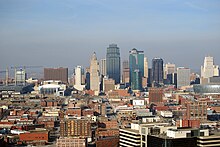
The history of the Kansas Metropolis metropolitan area has records starting in the 19th century, every bit Frenchmen from St. Louis, Missouri moved up the Missouri River to trap for furs and trade with the Native Americans. The Kansas City metropolitan area, straddling the border between Missouri and Kansas at the confluence of the Kansas and Missouri Rivers, became a strategic point for commerce and security. Kansas City, Missouri was founded in 1838 and defeated its rival Westport to become the predominant urban center west of St. Louis. The surface area played a major part in the westward expansion of the United States. The Santa Fe, and Oregon trails ran through the area. In 1854, when Kansas was opened to Euro-American settlement, the Missouri-Kansas border became the starting time battlefield in the conflict in the American Civil War.
Exploration [edit]
Bourgmont [edit]
The first documented French visitor to the Kansas City area was Étienne de Veniard, Sieur de Bourgmont, who was also the first European to explore the lower Missouri River. Bourgmont was on the lam from French authorities after deserting his post as commander of Fort Detroit, after being criticized for his handling of a Native American attack on the fort. He lived with a Native American married woman in the Missouri village about 90 miles (145 km) eastward near Brunswick, Missouri, and illegally traded furs.
In order to articulate his name, Bourgmont wrote "Exact Clarification of Louisiana, of Its Harbors, Lands and Rivers, and Names of the Indian Tribes That Occupy It, and the Commerce and Advantages to Be Derived Therefrom for the Institution of a Colony" in 1713 followed in 1714 by "The Route to Be Taken to Ascend the Missouri River". In these documents, he described the junction of the Kansas and Missouri rivers, being the first to refer to them by those names. French cartographer Guillaume Delisle used the descriptions to brand the starting time reasonably authentic map of the expanse.
The French rewarded Bourgmont past giving him their highest honors and naming him commander of the Missouri. He built the starting time fort (and first extended settlement in Missouri) in 1723 at Fort Orleans, near his Brunswick domicile. In 1724, Bourgmont led a grouping of Native Americans probably up the Kansas River en route to the southwest to set an brotherhood with the Comanche to fight the Spanish, thereby creating a New French republic empire extending from Montreal through Kansas Metropolis to New Mexico. To celebrate the success of the venture, he took the Native American chiefs on a junket to Paris to hunt with Louis 15 and see the glory of French republic at Versailles and Fontainebleau.
Bourgmont got promoted to official noble condition and stayed in Normandy, not accompanying the chiefs back to the New World. According to legend, the Native Americans so slaughtered everybody in the Fort Orleans garrison. The Spanish took over the region in the Treaty of Paris in 1763, but were not to play a major role in the area other than taxing and licensing all traffic on the Missouri River. The French connected their fur trade on the river under Spanish license.
Lewis and Clark era [edit]

Frank Bail'southward illustration of the Louisiana Purchase
Following the Louisiana Buy of 1803, the Lewis and Clark Expedition left St. Louis on a mission to achieve the Pacific Sea. In 1804, Lewis and Clark camped for three days at the confluence of the Kansas and Missouri rivers. During their stay at the confluence of the Missouri and Kansas, they met French fur traders and mapped the area of Quality Hill in what would somewhen become Kansas Urban center, Missouri, calling information technology "a fine place for a fort". This became Kansas City, Kansas, memorialized at Kaw Bespeak Park.
Because of the burgeoning trade up the Missouri River from St. Louis, especially following Lewis and Clark's expedition, the United States Authorities sought to create government posts all throughout the surface area. In 1808, Fort Osage was established 20 miles from the confluence of the Missouri and Kansas Rivers near present-day Sibley, Missouri.
Kaw'south Mouth [edit]
In 1812, after Louisiana officially became a land, the remaining portions of the original Louisiana Territory north of Arkansas were renamed the Missouri Territory. As plans were fabricated to divide up the territory for the entry of Missouri into the union, it was determined that the western border of the new state would run from Iowa forth the Missouri River to the confluence of the Kansas River (Kaw) and the Missouri River, then every bit a straight line running due south to the northwest corner of Arkansas. Every bit part of the Missouri Compromise in 1821, Congress admitted Missouri to the union every bit the 24th state and as a slave state. The area of the confluence of the ii rivers, alternately known every bit the hamlet of Kansa, Chouteau'due south, Quindaro, Westport Landing, Missouri River Quay, Town of Kansas, City of Kansas, and finally Kansas City, has been subject area to several floods and river course changes. Since 1800, the confluence has moved almost a quarter mile upwardly the Missouri River.
Early to mid-1800s [edit]
Native Americans [edit]
Missouri joined the Spousal relationship in 1821 and, later on the Treaty of St. Louis in 1825, the 1,400 Missouri Shawnees were forcibly relocated from Greatcoat Girardeau to southeastern Kansas, shut to the Neosho River. In 1826, the Prophet Tenskwatawa established a village in Argentine, Kansas. During 1833, but the Blackness Bob's band of Shawnee resisted the relocation efforts. They settled in northeastern Kansas, near Olathe and along the Kansas River in Monticello, nearly Gum Springs. Tenskwatawa died in 1836 at his village in Kansas City, Kansas (ed., the White Plume Spring marker notes the location).
Early on European settlers [edit]
The language of the start European settlement in Kansas City was French. In 1821, 24-yr-sometime François Gesseau Chouteau, nephew of René Auguste Chouteau, set a permanent trading post in the cracking bend in the Missouri River that makes up the Northeast Industrial District (crossed today by Chouteau Trafficway). He referred to the post equally "the village of the Kansa". In 1825, later Indians agreed to leave the westernmost six miles of Missouri to the confluence of the Kansas, the area was referred to as "Chouteau's". In 1826, Chouteau moved his trading mail service to college basis, Troost Avenue and the river, post-obit a flood. He also financed the first Catholic church, which was built on Quality Hill.[1]
The area was soon populated by trappers, scouts, traders, and farmers, leading to the incorporation of Jackson County, Missouri, in 1827 and the founding of the town of Independence, located approximately 10 miles (xvi km) from the river junction, every bit its county seat. As the number of farmers increased, the fur traders retreated northward. In 1831, Moses Grinter established a ferry on the Kansas River on the onetime Indian trail past the Kaw'due south h2o. Grinter was ane of the earliest permanent white settlers in the Kansas City, Kansas, area.
Latter Day Saint movement [edit]
In 1831, members of Church of Christ, the original name of the Latter Day Saint church founded by Joseph Smith, came from Kirtland, Ohio, and New York State and purchased about 2,000-acre (8.1 km2) of land in the Paseo and Troost Lake areas. Conflict between the Saints and other Missouri residents led to the eviction of the Latter Twenty-four hour period Saint from Jackson Canton in 1833 and the 1838 Mormon War.
Afterward, various groups of Latter Day Saints returned to Jackson Canton, the first of whom were members of the diminutive Church of Christ (Temple Lot), rapidly followed past adherents to the Reorganized Church of Jesus Christ of Latter Day Saints under the leadership of Joseph Smith Iii and members of other factions, several of whom had established their headquarters in nearby Independence, Missouri.
The Church building of Jesus Christ of Latter-day Saints (LDS Church building) is the largest sect in the Latter Day Saint motion and is headquartered in Salt Lake Urban center, Utah. The LDS Church building opened the Kansas City Missouri Temple on May 6, 2012.[2] [3]
Westport and Westport Landing [edit]
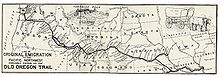
Over the next years, the grapheme of Kansas City was defined by those who wanted to live close to the river (who were referred to as "Rabbits") and those who wanted to live in the hills (the "Goats"). John Calvin McCoy, who is considered the "male parent of Kansas Metropolis", had a mitt in establishing settlements in both locations. In 1833, he opened a trading mail in the hills three miles due south of the river. McCoy named it "West Port" because it was the last place to get supplies before travelers went into Kansas Territory on the California Trail, Santa Fe Trail, and Oregon Trail. McCoy got supplies from boats that docked at a rocky outcropping on the river at what is Primary Street and the river; the expanse was called "Westport Landing". McCoy's landing and Chouteau'southward trading post drove traffic to the last outpost before settlers traveled up the Kansas River or Missouri River. The road connecting Westport with the trading post and Westport Landing followed Broadway. In 1834, the steamboat John Hancock, which was laden with goods for McCoy, became the first steamboat to dock at the Westport Landing and opened upward a new era of communication and transportation for the area.
Town of Kansas [edit]
Expansion effectually the landing was stifled because it was a farm more often than not owned by Gabriel Prudhomme. In 1838, McCoy, Chouteau, and other merchants formed the Town of Kansas Company and purchased Prudhomme'due south 271-acre (ane.one kmtwo) farm for US$4,220 (equivalent to about $107,000 in 2021). The investors rejected other names for the new town including Port Fonda, Rabbitville and Possum Trot. The adjacent twelvemonth, in 1839, Chouteau died, and the area outside of Westport Landing was renamed the Boondocks of Kansas.
Throughout the 1840s, the population and importance of the Boondocks of Kansas swelled every bit it and nearby Independence and Westport became starting points on the Oregon, Santa Fe, and California trails for settlers heading due west. Between St. Louis and California, the Kansas/Missouri river junction was one of the few substantially populated areas. The first rail travel came to the Town of Kansas in 1847.
Jackson County finally formally incorporated the Town of Kansas on June 3, 1850 (traditionally viewed equally the date of Kansas Metropolis's founding). Its population was approximately i,500 people. The first paper (the now-defunct Kansas Urban center Ledger) and first telegraph service were established in the Town of Kansas in 1851.
City of Kansas [edit]
Missouri officially incorporated the city on March 28, 1853; it changed the name to the City of Kansas. At the first municipal election in 1853, there were 67 voters from an estimated population of 2,500. The initial incorporated area was most 10 blocks west to east and v blocks north to s. It was bordered by Bluff Road (virtually the location of present-24-hour interval Interstate 35) on the west, Independence Avenue on the south and Holmes Street on the due east and the Missouri River on the north. William S. Gregory became the first mayor only had to resign within 10 months when information technology was discovered that the mayor actually had to alive in the city.
Border State of war [edit]
At the fourth dimension of the City of Kansas's incorporation, Missouri was still a slave state. Nevertheless, the population was securely divided over the upshot of slavery. In 1854, the Us Congress passed the Kansas–Nebraska Deed, which rejected the 1820 Missouri Compromise and allowed new territories to cull whether they wished to allow slavery, whereas the Missouri Compromise had prohibited slavery in whatever new states to be created north of latitude 36°thirty'. Thus, according to the Missouri Compromise, Kansas Territory (located immediately to the due west of the City of Kansas, Missouri) had been a free territory but now could choose to let slavery.
As a result of the new potential for slavery in Kansas, pro-slavery activists infiltrated Kansas Territory from the neighboring slave state of Missouri. To abolitionists and other Free-Staters, who desired Kansas to exist admitted to the Marriage as a gratuitous state, they were collectively known as Edge Ruffians. Pro-slavery Missourians flocked to Kansas in strength, electing a pro-slavery Kansas Territorial Legislature. In response, abolitionists began arriving in the area, and in 1855 they alleged the Kansas Territorial Legislature "bogus" and elected their ain representatives to grade a new territorial authorities in Lawrence, Kansas (approximately 35 miles (56 km) west of the City of Kansas). The newly established Urban center of Kansas shortly found itself in the eye of a dispute known as Bleeding Kansas.
During the conflict, the Metropolis of Kansas continued to grow speedily. It gained a courthouse, city market, and bedchamber of commerce in 1857. In 1858, nevertheless, the local violence had grown so fierce that the Kansas Territorial Governor and the State of Missouri both asked U.S. President James Buchanan to send in federal troops. The president agreed, and with the troops' presence the violence seemed quelled.
Ceremonious War [edit]
Missouri stayed in the Union during the Civil War. However, since the city's commencement settlers had arrived via the Missouri River from the S, considerable tension existed there between pro-Union and pro-Amalgamated sympathizers. Missourian Sterling Price was to fight battles in the area at the beginning and finish of the state of war, hoping to incite residents to join the Southern cause. Thus, the City of Kansas and its firsthand environs became the focus of intense military machine activeness. The Showtime Battle of Independence resulted in a Confederate victory, but the Southerners were not able to follow information technology up in whatsoever meaningful way, as the City of Kansas was occupied past Union troops and proved likewise heavily fortified for them to assault.
In 1863, William Quantrill sacked and burned Lawrence, killing 168 people in what was called the Lawrence Massacre. Union General Thomas Ewing, Jr., believing that the raid was rooted in the four Missouri counties on the Kansas border south of the Missouri River, promulgated his General Order No. 11 which ordered the eviction of all those living in rural areas outside of designated urban areas, regardless of their loyalty. This order afflicted those living south of Brush Creek and eastward of the Blue River, and proved a source of resentments that lingered long after the war. The city's first mayor was exiled to St. Louis.
In 1864, Price invaded Missouri in a concluding-gasp Confederate offensive called Price's Raid. He pushed Marriage troops out of Independence in the Second Battle of Independence and into the Urban center of Kansas, resulting in the pivotal Battle of Westport in Oct of that year near Brush Creek. Price was decisively defeated and forced out of the state, ending all significant Amalgamated war machine operations in the area.
Later the war, Kansas City remained a hotbed for former pro-Southerns. John Newman Edwards founded the Kansas City Times to stringently object to Republican rule. He also created the Jesse James anti-hero myth, with James equally a modern-twenty-four hours Robin Hood fighting an unjust Republican Reconstruction. Jesse James went on to rob the Kansas City fairgrounds at 12th Street and Campbell, all the while living at various places throughout the metropolitan area.[4]
Mid to tardily 1800s [edit]
Crossroads of the country [edit]

Aerial view of Kansas City, Missouri, January 1869, drawn by A. Ruger, Merchants Lith. Co.
In 1865, the Missouri Pacific railroad reached Kansas Metropolis. At the fourth dimension, Kansas Urban center was similar in population to Independence and Leavenworth, Kansas. That was to alter in 1867, when Kansas City defeated Leavenworth (then over twice Kansas City's size) for the Hannibal & St. Joseph Railroad bridge over the Missouri River. The Hannibal Bridge, designed by Octave Chanute, opened in 1869. With that, the metropolis'southward population quadrupled in fifty years.
In 1889, with a population of around 130,000, the metropolis adopted a new charter and inverse its name to Kansas City. In 1897, Kansas City annexed Westport. The initial meeting of tracks occurred in the West Bottoms an area that had previously been used to outfit travellers on the Oregon and Santa Atomic number 26 trails who had followed the Kansas River. The biggest outfitting facility was the Central Overland California and Pikes Tiptop Express Company. That company went out of business organization following the collapse of the Pony Limited. Its facilities were to become the Kansas Metropolis Stockyards. The city has since been the second to Chicago as busiest train center in the land. In 1914, the city'southward Union Station in the W Bottoms became outdated and the new Union Station was built.
Cow town [edit]

Kansas City Stockyards in 1904 with the Livestock Exchange Edifice
In 1871, the Kansas City Stockyards boomed in the West Bottoms because of their central location in the state and their proximity to trains. They became 2nd only to Chicago's in size, and the metropolis itself was identified with its famous Kansas City steak. In 1899, the American Hereford Association hosted a cattle judging contest in a tent in the stockyards. That event soon became the annual American Royal 2-month-long livestock festival. The Kansas City Stockyards were destroyed in the Great Flood of 1951 and never fully recovered.
Strawberry Hill [edit]
In 1887, John G. Braecklein synthetic a Victorian home for John and Margaret Scroggs in the surface area of Strawberry Hill. It is a fine example of the Queen Anne Way architecture erected in Kansas City, Kansas.
1890s to 1940 [edit]

Pendergast era [edit]
The Pendergast era, under Democrat large metropolis bosses James and Tom Pendergast from 1890 to 1940, ushered in a colorful and influential era for the metropolis. The Pendergasts presided over an era in which many outsized personalities shaped the city and contributed to the whole country. During this period, the Pendergasts ensured that national prohibition was meaningless in Kansas City; the Kansas Urban center boulevard and park arrangement was developed; the State Lodge Plaza, State Club District, and Ward Parkway were created; TWA fabricated Kansas Metropolis the hub of national aviation; most of the downtown Kansas City buildings were built; its inner city culture blossomed with contributions to Negro league baseball, Kansas Urban center jazz music, and Kansas City-way barbecue cuisine; the stockyards and train station were second only to Chicago; and Harry South Truman, from nearby Independence, became President. Much of the structure during these "broad open up days" used Pendergast Readi-Mix Concrete, and the era was marked by considerable violence and corruption. Pendergast was ultimately defanged with a 1939 income revenue enhancement evasion accuse.
Prohibition [edit]

Walnut St., Downtown Kansas City, Missouri. 1906
Kansas enacted statewide prohibition on February 19, 1881. In Kansas Metropolis, however, residents on the Kansas side of the surface area who wished to drink simply went beyond the state line to Kansas Urban center, Missouri, to the many saloons and taverns in that location. 12th Street in Downtown Kansas City was known for its large number of taverns.[5] During the ongoing temperance movement, notwithstanding, Missouri never enacted statewide prohibition. Missourians actually rejected statewide prohibition in 3 divide referenda in 1910,[6] 1912, and 1918, all of which were brought by citizens' initiative petitions.[seven] In Apr 1901, famous temperance crusader Carrie A. Nation came to Kansas City and began to enter the saloons on twelfth Street and smash liquor bottles with her hatchet. When she entered Flynn's Saloon on April 15,[8] she promptly was arrested, hauled into Police force Court (known today as the Municipal Court of Kansas City), fined U.s.a.$500 (equivalent to $16,286 in 2021), and ordered by a gauge to get out Kansas City and never return.[9]
When prohibition finally was imposed on Missouri in 1919 by ways of the 18th Amendment and the subsequent Volstead Act, Kansas City remained substantially unaffected, mostly due to the Pendergast machine.[10] Due to Pendergast, prohibition simply "never existed in Kansas City" considering he kept the bars open, the liquor supplied, and Kansas Urban center'south federal prosecutor on his payroll to never bring a unmarried felony prosecution under the Volstead Act. Dr. George Miller, the editor of the Omaha Herald, even remarked, "If yous want to run into some sin, forget about Paris. Go to Kansas City."[eleven] And then, when prohibition finally was repealed in 1933 by means of the 21st Amendment, very footling changed in Kansas City.
World War I memorial [edit]
The Liberty Memorial, which houses The National World War I Museum, was dedicated on November eleven, 1926, by U.Due south. President Calvin Coolidge. In attendance at the groundbreaking ceremony on November ane, 1921, were Lieutenant General Businesswoman Jacques of Belgium, Admiral Lord Earl Beatty of Slap-up United kingdom of great britain and northern ireland, General Armando Diaz of Italia, Marshal Ferdinand Foch of French republic and General John Pershing of the United states. In 1935, bas reliefs by Walker Hancock of Jacques, Beatty, Diaz, Foch and Pershing were unveiled.
Union Station massacre [edit]
Violence and gangster activity proliferated during this time as well. On June 17, 1933, three gangsters attempted to free Frank Nash from FBI custody, only wound upwardly killing him and four unarmed agents. This is known equally the Union Station massacre. The gangsters had spent the prior evening at the Hotel Monroe, adjacent to Pendergast's office, and had received help in eluding a bribed police force from John Lazia, a major underworld figure with connections to Pendergast.
Political history [edit]
James Pendergast [edit]
In 1880, James Pendergast, the oldest son of Irish immigrants, moved to Kansas City'south Westward Bottoms. He worked at a local iron foundry until he bought a bar with money he won from betting on a longshot horse (Climax) at a local race track. From his new bar, Pendergast began networking with local leaders and soon congenital a powerful faction in the Jackson County Democratic Party. Pendergast'south faction was called the "Goats", because they were backed by those living in the hills in a higher place the river. His primary rivals were the "Rabbits" because they tended to come up from the area effectually the rivers. The lead of this faction was Joe Shannon.
Tom Pendergast [edit]
Just prior to winning his first of nine terms on the city council in 1892, James summoned his youngest blood brother Tom from nearby St. Joseph. Every bit Jim'south health deteriorated, Tom began to use many of his blood brother's connections to pb the "Caprine animal" faction after Jim's death in 1910. Tom succeeded Jim in the council also, but left after three terms and assumed a more than powerful position as chairman of the Jackson Canton Autonomous Club with its headquarters at 1908 Primary Street.
Metropolis manager [edit]
In 1925, Kansas Metropolis, Missouri, voted in favor of establishing a urban center director-based government with i metropolis council of 12 members instead of two chambers of 32 members total, giving Tom an easier road to gaining majority control. By 1925, the Pendergast auto had established a majority, appointing a passive mayor and powerful metropolis director Henry F. McElroy. Pendergast'due south power grew during the Bully Low, creating a Ten-Twelvemonth Program bond plan aimed at putting unemployed Kansas Citians to work building civic structures that nevertheless stand, including City Hall, Municipal Auditorium, and the Jackson County Courthouse. These structures, sporting art deco architecture, were congenital with concrete supplied by Pendergast's Ready-Mixed Physical company and other companies that provided kickbacks to Pendergast.
At its peak, the machine wielded considerable influence on land politics, handily electing Platte County judge Guy Brasfield Park governor of Missouri in 1932 when the Democratic candidate Francis Wilson died two weeks earlier the election. Also during this fourth dimension, Kansas Metropolis also became a center for nightlife and music, with jazz by musicians such every bit Count Basie and Charlie Parker, and blues flourishing in areas such as 18th and Vine. Pendergast'due south machine became synonymous with inflating ballot results by bringing in out-of-town hoodlums to vote for machine candidates repeatedly. The March 27, 1934, municipal elections (dramatized in Robert Altman's 1996 film Kansas City) resulted in nine deaths.
Machine's demise [edit]
Tom Pendergast's power was brought down past wellness ailments and a determined effort by The federal treasury section forth with local reform leaders, capped by Tom pleading guilty to tax evasion on May 24, 1939. Remnants of the motorcar lingered until the 1950s. His biographers have summed up Pendergast'due south uniqueness:
Pendergast may bear comparison to various big-city bosses, but his open alliance with hardened criminals, his cynical subversion of the democratic process, his monarchistic style of living, his increasingly insatiable gambling habit, his grasping for a business empire, and his promotion of Kansas City as a wide-open town with every kind of vice imaginable, combined with his professed compassion for the poor and very real function as city builder, made him bigger than life, difficult to narrate.[12]
Personalities [edit]
Walt Disney [edit]
Walt Disney moved to Kansas City with his family in the early on 20th century. He attended weekend classes at the Kansas City Art Establish and was said to take been inspired to make the affectionate depiction of a mouse after seeing i in his function in Kansas Urban center. Afterwards World War I, Disney ran his first animation studio at the Laugh-O-Gram Studio from 1921 to 1923 Kansas City.
Joyce Clyde Hall [edit]
J.C. Hall founded greeting card visitor Hallmark Cards with his brother Rollie in the early 20th century, by get-go selling Valentine's Day cards. He expanded the corporate headquarters into Crown Center shortly earlier he died in 1982.
TW&A [edit]
Charles Lindbergh helped lure the newly created Transcontinental & Western Airline (TW&A) – subsequently Trans World Airlines (TWA) – to locate its corporate headquarters in Kansas Metropolis, because of the city's primal location. During the latter role of the Golden Age of Aviation, the 1930s and 1940s, TWA was known equally "The Airline Run past Flyers". With most 300 employees prior to World War Two, the airline somewhen employed more than 20,000 people from the metropolitan area.
William T. Kemper [edit]
William T. Kemper became the scion for a powerful financial family that had controlling involvement of the city's two biggest banks, Commerce Trust Company (at present Commerce Bancshares) and Urban center Center Bank (subsequently City National Bank, now UMB Financial Corporation). The family unit has influenced financial endeavors throughout Missouri and Kansas, including Kemper Arena and the Kemper Museum of Contemporary Art. William became president of Commerce. Ane of his sons, R. Crosby Kemper, controlled United Missouri Banks while the other son, James Madison Kemper, took over Commerce.
William Rockhill Nelson [edit]
William Rockhill Nelson founded the Kansas City Star in 1880, and was to eventually take over its prime number competitor, the Kansas Metropolis Times. Nelson was a major supporter of the Democratic Party and an urban booster. At the urging of his paper, the city built Memorial Hall in 1899 to attract the 1900 Democratic National Convention. The hall burned in early on 1900 was rebuilt in 90 days in time for the convention. Nelson left provisions that his house ultimately be torn down to create the Nelson-Atkins Gallery of Art.
J. C. Nichols [edit]
Beginning in 1906, programmer J. C. Nichols created a planned upscale customs called the State Club District, located south of Brush Creek. This development is well known for the beautiful Ward Parkway, a wide, divided and manicured boulevard that gently slides northward and due south through the neighborhood. The parkway is lined with several large and attractive homes. In the 1920s, Nichols created the Country Social club Plaza, a shopping district and neighborhood along Brush Creek modeled afterwards the city of Seville, Kingdom of spain. "The Plaza" is the world's first shopping middle specifically designed to accommodate shoppers arriving by automobile. It is nevertheless 1 of the about popular shopping and dining venues in Kansas City – day and night. Every Thanksgiving evening, throngs of Kansas Citians flock at that place to lookout man the traditional Lighting of the Plaza, which kicks off the Christmas shopping flavor.
Harry S Truman [edit]
Harry S Truman, who was born in Lamar, Missouri, only grew up in Jackson County, started a haberdashery in downtown Kansas City subsequently Globe War I. When his business organisation failed, he asked Pendergast for a chore and wound up an Eastern Jackson Canton estimate (in actuality, a county commissioner position). Truman was later promoted to Senator. He was one of the few politicians who attended Tom Pendergast's funeral in 1945, just a few days after he became Vice President, and eventual President of the Usa when Franklin Roosevelt died on April 12, 1945. Truman went on to win the following presidential ballot in 1948 and served another term.
R. A. Long [edit]
In 1873, Robert A. Long – who was born in Shelby Canton, Kentucky in 1850 – moved to Columbus, Kansas and with a friend and a cousin, Victor Bell and Robert White, started a hay business organization. Their business was unsuccessful, only there seemed to exist a need for lumber so the 3 formed R. A. Long & Company. After White'due south death, the two remaining founders formed the Long-Bell Lumber Company in 1887 and the visitor's headquarters were moved to Kansas City. Information technology became a very lucrative business, and made Long a millionaire. Other milestones achieved past Long included being a lumber baron, programmer, investor, newspaper owner, and philanthropist. He congenital the towns of Longville, Louisiana and Longview, Washington. In 1907 he congenital the R.A. Long Edifice, the start steel framed skyscraper, in Kansas City. The edifice was bought by Metropolis National Bank & Trust Company in 1940. Long was a founding member and president of the Liberty Memorial Association that secured funding for the memorial. James M. Kemper served every bit treasurer, as well equally president of a bank. In 1911 Long congenital Corinthian Hall, a 72-room mansion; so in 1914, he built the Longview Farm.
18th Street & Vine [edit]
1 of the about dramatic developments of the era was the flourishing of the inner city neighborhood of 18th Street and Vine.
Kansas City Monarchs [edit]
The Kansas City Monarchs played at Municipal Stadium and were one of the premier baseball game teams in the Negro leagues with title teams and stars such as Satchel Paige, Jackie Robinson and John Jordan "Buck" O'Neil.
Kansas Urban center Jazz [edit]
With Kansas City not enforcing liquor laws and clubs being allowed to stay open all nighttime, musicians began all-night jam sessions subsequently performing in structured large band performances. The Kansas Metropolis sound was difficult-driving, riff-bass and blues oriented. This was the surroundings in which Charlie Parker developed in his early years before heading to New York Metropolis and laying the foundations for bebop.
Kansas Metropolis-style barbecue [edit]
Henry Perry first introduced a Memphis-manner barbecue to the metropolis from his restaurant in the 18th Street and Vine area in the early on 20th century. Arthur Bryant later added more molasses to the recipe when he took over Perry's restaurant. Gates Bar-B-Q which was opened in 1946, by George Due west. Gates, is the only remaining family unit owned barbecue eating place in the area. Information technology is also the only sauce and production manufacturer based in Kansas City. The still family unit owned business organization is owned and operated past Ollie W. Gates. In 1986, Rich Davis sold KC Masterpiece Bar-B-Q Sauce to the Kingsford charcoal sectionalisation of Clorox.
Crossroads of the globe [edit]
The period between the 1940s and the 1970s was a heady time when Kansas Metropolis was sometimes considered the crossroads of the world. This was fueled by the Presidency of hometown native Harry Truman from 1945 to 1953, followed immediately past Kansan Dwight D. Eisenhower from 1953 to 1961. From the 1930s and office of this period TWA, nether the leadership of Jack Frye, Paul Due east. Richter, and Howard Hughes as a stockholder, was headquartered in Kansas City. The city planned to turn the cosmopolitan hub into the gateway to the world. But the era'south great expectations died down with the diminished presence of TWA.
1940s [edit]
After the autumn of the Pendergast machine, reformer John B. Cuff was elected mayor in 1940 and L. P. Cookingham was named urban center director. Gage was elected mayor three times and served until 1946, while City Manager Cookingham served until 1959. The Gage and Cookingham government sought to "clean up" Kansas City from its corrupt by and enact "fair" government practices and merit-based hiring of city employees.
The war endeavour brought defence force jobs to Kansas City, which was still suffering from the Corking Low, including the Pratt & Whitney engine plant. Other armaments plants in Kansas City, Kansas and eastern Jackson County provided additional jobs to the region. This was a relatively prosperous time for the urban center. In 1945, Jackson County resident Harry Truman became President of the United States, following the expiry of Franklin Roosevelt.
Looting [edit]
In the mid-1940s, the Gage and Cookingham government began to annex land to expand the city's size. The city increased its geographical size to five times its size in 1940, with the annexation programs continuing through the 1970s. Following World War Ii, Kansas Urban center, like virtually all other metropolitan areas, experienced significant lower density expansion, which was fueled principally by motility from outside the area and also by population shifts from the city'due south cadre to the suburbs. While other cities shrank, the newly annexed country helped Kansas Metropolis retain its population. Growth since 1970, however, has been limited and oft negative, even during a pocket-size population growth in the 1990s.
1950s [edit]

1950 stamp commemorating Kansas Metropolis's centennial
Since the 1950s, Kansas City has gone through a transition and tried to shed its Cow Town paradigm. This began when Kansas City was at its height of national attending with the back-to-back Presidencies of Harry Truman and Kansas favorite-son Dwight D. Eisenhower. Events of the catamenia saw the heyday of Roy A. Roberts' influence as editor of the Kansas City Star.
The change began in the early 1950s with the precipitous reject of the railroad due to contest from automobile and jet travel. Matrimony Station, which had lorded over the second busiest rail intersection (adjacent to Chicago), began a rapid reject. The Bang-up Flood of 1951 decimated the Kansas City Stockyards in the West Bottoms. The stockyards (which were likewise second to Chicago in size) never came dorsum to their total glory every bit stockyards moved away from urban and unionized centers. In 1955, Kansas City formally began its human relationship with major league sports when the Philadelphia Athletics relocated to the city, becoming the Kansas Urban center Athletics, playing at Municipal Stadium.
1960s [edit]
The 1960s contained many projects coupled with the rapid urban decay of many inner city neighborhoods. During this period, many historic buildings were demolished to make way for parking lots, and role buildings. The area became primarily for business organisation rather than for everyday city life.
During this inner city decay, Kansas City began to annex land and aggrandize its area. In the process, Kansas City eventually became ane of the largest cities in the United States area-wise at 318 square miles (824 km2), while its population decreased by 15,000 between 1950 and 2000. It is still not uncommon to observe cattle and corn fields on the extreme edges of Kansas City. In 2000, Kansas City ranked as the 21st largest city in the United States in terms of area, while information technology placed 40th in population rankings.

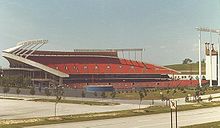
Kauffman Stadium, c. 1981, has since redecorated in the team colors of blue and white.
In 1967, the Kansas Metropolis Chiefs participated in the offset e'er Super Bowl, losing to the Green Bay Packers. That aforementioned year, Charlie Finley got permission to move the Kansas City Athletics out of the 1923-era Municipal Stadium. Kansas City responded to these developments past blessing a bond issue to build the Truman Sports Circuitous on the extreme suburban eastern edge of the city by the intersection of Interstates 70 and 435. The construction of the circuitous was so successful that many major league ballparks and football stadiums take been designed in accordance with the Truman Complex master plan, and well-nigh accept been designed by Kansas City architects.
Too in 1967, work began on the Crown Center complex located around the headquarters of Authentication Cards. Another development in the 1960s was the approval of a bond upshot to move the metropolis's chief airport from Kansas City Downtown Airport to the TWA Kansas City Overhaul Base at what was formerly called Mid-Continent International Drome – now chosen Kansas Urban center International Airdrome (simply which is referred to in baggage tags past its original abbreviation of MCI). Although Kansas City continued to expand outward in the 1960s, the inner urban center endured numerous heartbreaks, fires and a 1968 anarchism that followed the assassination of Martin Luther King Jr. White flight connected on a large calibration, ironically, resegregating the urban center fifty-fifty further than it was before the Civil Rights Movement.
1970s [edit]
The first one-half of the 1970s was dominated by Kansas City'southward ambitious urban renewal projects that were showcased when the city hosted the 1976 Republican National Convention. Though these projects did little to bring people back to the urban center, they removed many historic buildings in favor of more parking, and more than office structures, also as public housing projects.
New arenas and teams [edit]
After Charlie Finley moved the Kansas City Athletics to Oakland, California, Missouri Senator Stuart Symington threatened to remove professional baseball'southward antitrust exemption. Major League Baseball responded by awarding an expansion team to Kansas City which started play in 1969 nether Ewing Kauffman. The Royals had winning seasons by 1971 and moved into their new domicile in the Truman Sports Complex at Royals Stadium (now Kauffman Stadium) in 1973, beginning a decade in which they appeared in the World Series 2 times (winning in one case) and won six American League Westward division titles. In 1972, the Kansas City Chiefs played their commencement game at the new Arrowhead Stadium. Ironically the Chiefs football franchise, who had defined Kansas Metropolis in the 1960s and those heady days at Municipal Stadium, went into a refuse, having only two winning seasons between 1974 and 1988 and participating in merely one playoff game from 1972 through 1989.
In 1972, Kansas Urban center caused a National Basketball Association team, the Cincinnati Royals, with promises of building a new indoor arena. Kemper Loonshit, which was the commencement major project past architect Helmut Jahn, was congenital in 18 months from 1973 to 1974 at the one-time location of the Kansas City Stockyards in the Westward Bottoms. Its construction was financed by general obligation bonds, donated land from the stockyards, donations from the American Royal and R. Crosby Kemper Sr. The arena was considered an architectural gem because of fast-track construction, and the fact that with external supports, in that location were no obstructions to sight lines. The arena was seen as the crowning achievement for luring the 1976 Republican Convention. The arena likewise resulted in Kansas City being awarded a National Hockey League expansion team, the Kansas City Scouts, which began play in 1974.
KCI Airport [edit]
The Kansas City Downtown Airport, which was built initially during the Pendergast in the Missouri River bottoms immediately due north of downtown, was convenient. All the same, information technology lacked room for expansion and jets landing and taking off had to avoid the 200-foot (61 m) loftier bluffs, and the neighborhood of Quality Hill at its south edge. TWA, which was headquartered in Kansas City at the time, had an overhaul base of operations with a landing strip surrounded past open farm country 15 miles (24 km) north of downtown in rural Platte County, Missouri. The airport was listed on maps as Mid-Continent International Airport.
In 1966 voters approved a $150 million bail issue to motility the city's main drome to an expanded Mid-Continent. All the same, the city did not annex the area, and instead the small town of Platte City, Missouri did. Following a series of court battles, Kansas City eventually annexed the drome and selected architectural firm Kivett and Myers to design it, which was dedicated in 1972. Most all the airlines that were hubbed at the old facility moved to the new airport, which was renamed Kansas Urban center International Airdrome. The international designation was applied considering of jets at the airport that traveled to and from United mexican states. The "MCI" abridgement remained because it was an existing drome and had already been listed on navigation charts.
On November 7, 2017, two weeks later KCI'south 45th anniversary, Kansas Urban center Missouri voters overwhelmingly canonical a new privately financed and constructed single terminal at KCI. The New Final will replace the existing decrepit "Clover Leafage Terminals" and is expected to open in late 2021.
River Quay [edit]
One of the nearly tragic times during this period occurred when a gangland war broke out among the Kansas City Mafia over control of the newly created and thriving River Quay entertainment district, and control over mob skimming at the Stardust Resort & Casino in Las Vegas. In the process, several mobsters were killed and 3 buildings were blown upwardly in the River Quay, which finer ended its office as Kansas City's entertainment center. The battle ended the era of mob control of the Las Vegas casinos.
The River Quay in the City Market area along the Missouri River on the n edge of Downtown Kansas Metropolis, had been a 1970s urban renewal project to offer a more family friendly amusement complex based on the city'south jazz heritage, replacing the establishments along 12th Street which had deteriorated into a heart for crime, drugs, and prostitution. The battle over mob skimming in Las Vegas was highlighted in the volume Casino and its based upon movie by Nicholas Pileggi.
Big storms [edit]
Although the Kansas Urban center area, which is in Tornado Alley, is ordinarily hit with at to the lowest degree one and often many more tornadoes each year, two major non-tornadic storms had profound effects on the city. On September 12, 1977, following a soggy summertime, 16 inches (410 millimetres) of rain fell on Kansas City, causing severe flooding beyond the entire region. The near dramatic flooding was in the Country Club Plaza neighborhood, along Brush Creek. The storm killed 25 people, and caused most $100 million in property impairment.[13] On June 4, 1979, a astringent thunderstorm that moved through the city that evening collapsed the roof of Kemper Loonshit. As the loonshit was not belongings an event that night, no one was injured at the facility. Initial reports indicated that the collapse was the result of a downburst. Nonetheless, an investigation later revealed that heavy rain from the storm had collected on the arena's roof, to the betoken where the supports were unable to handle the weight of the pooled water coupled with high winds that rocked its outside skeleton. The loonshit was repaired and reopened in early 1980.
Pocket-size marketplace major league [edit]
Kansas City'southward grandiose dreams began to diminish in the 1980s as TWA and the major league hockey and basketball teams left and the NCAA stopped holding its Last Four games in the city. The Kansas City Scouts were unable to create the same buzz as fellow NHL franchise, the St. Louis Blues, and relocated to Denver in 1976 to become the Colorado Rockies (which later became the New Jersey Devils in 1982). In 1986, the Kansas Metropolis Kings were relocated to Sacramento, California to go the Sacramento Kings. Kansas City began to settle into the fact that it was one of the smallest markets with major league teams, ranking #31 by tv marketplace size. The period since 1980 has been marked past substantial bail problems by the city to protect its historic buildings, such as Union Station and Liberty Memorial, as well as to make major improvements to Kansas City International Airdrome and the Truman Sports Complex. Kansas City is now experiencing the biggest building boom in downtown since the Pendergast era.
1980s [edit]
Desegregation case [edit]
The single most divisive issue in Kansas City in the 1980s and 1990s was a school desegregation case that spanned three decades, cost millions of dollars, exist argued before the U.S. Supreme Court and exist featured in a profile on the CBS newsmagazine 60 Minutes about good intentions gone awry. By 1970 the Kansas Metropolis school district had experienced massive white and middle-class black flight that left information technology with a smaller tax base of operations and a severe coin shortage. The district increasingly depended on federal funding and could not beget to refuse large federal grants that required it to integrate faster. "Ultimately, the desegregation that was accomplished in Kansas City was far too niggling and came far likewise late, later the commune had lost most of its white students to the suburbs", says historian Peter Moran.[14]
The legal case began in 1977 when the Kansas City, Missouri School District sued its neighboring districts for funds to help it desegregate its schools. In the ensuing court battle, Kansas City'south school arrangement itself was put under a federal court judge guidance; the guess and so proceeded to order tax increases to improve the quality of the schools equally the system built its network of magnet schools, including ii loftier schools, Lincoln Higher Preparatory Academy and Paseo University. The battle dragged in the entire country of Missouri every bit schools outside the metropolitan area argued that they should not have to pay for Kansas Metropolis area schools. Farther, Kansas Urban center residents were angered over plans to jitney students an hour or more each solar day over the urban center's vast surface area.
At the height of the contend, the Kansas City, Missouri district spent more than $11,700 per educatee – the most of whatever big public school commune in the country. Teacher salaries skyrocketed, teacher-educatee ratios were 12 or xiii to 1 and some schools were equipped with Olympic-size swimming pools, wildlife sanctuaries and model United nations with simultaneous translation capability.[15] The Kansas City, Missouri School Commune had hoped to cease white flying to accomplish 35% white enrollment at about every school. Instead, over the life of the case, minority enrollment had grown from 67% to 84%.[16] In 1995, the U.South. Supreme Court ruled in the instance Missouri 5. Jenkins that the courts had exceeded their authority in the example. The example still continued to work its way dorsum through the courts, and in 2003, a federal courtroom judge finally released Kansas City from the judicial oversight.
Hyatt Regency walkway plummet [edit]
One of the biggest showcases of Kansas City metropolitan area'southward rebirth in this era was Crown Center, which was being built past Hallmark Cards, itself headquartered in the complex past Union Station. The newest improver to the complex was the Hyatt Regency Hotel, where on July 17, 1981, the building's walkway collapsed during a tea dance, which had been prepare up to bring back the magic of Kansas City jazz. The collapse killed 114 people, making information technology the deadliest structural collapse in U.S. history at the time, and injured more than 200 others. The Kansas City Star, which had been defenseless apartment-footed after the Kemper Arena collapse, hired a structural engineer following the Hyatt disaster and won a Pulitzer Prize for its coverage of the story.
Champions of the World [edit]
The Kansas City Royals helped boost the metropolis's morale in 1980, when they played their first World Serial (in which they were favored to win, simply lost to the Philadelphia Phillies four games to two), and so in 1985 in the "I-70 Series" with the intrastate rival St. Louis Cardinals. The 1985, the Royals won the Western Sectionalization of the American League for the second consecutive season and the sixth time in ten years. The team improved their record to 91–71 on the strength of their pitching, led by bullpen Bret Saberhagen's Cy Immature Award-winning performance. In the playoffs, the Royals went on to win the American League Championship Series for just the second time in its history. Both serial were won in vii games later losing three of the offset four games.
The championship series against the Cardinals, in which the Royals were the underdog, was forever remembered by umpires' diddled calls: 1 that cost the Royals a run in the 4th, and a "blown call" in Game 6 by umpire Don Denkinger that St. Louis fans claim led to the Royals tying the game. Even so, a dropped foul brawl by Jack Clark had as much or more to do with the Royals rally that inning. Regardless, St. Louis had no answer for Saberhagen in the following game every bit the Royals won their first globe championship over the Cardinals in Game 7, 11–0, and the series iv games to three.
The Royals returned to the Autumn Classic in 2022 losing in the seventh Game to the San Francisco Giants with the tying run just 90 feet away. In 2015, they returned once more and this time defeated the New York Mets in 5 games. The Royals won Game 1 in extra innings, tying for the longest game in World Series history. The Royals also won Game two with a consummate game by Johnny Cueto, who allowed just one unearned run and two hits. With the series shifting to New York, the Mets won Game 3 with home runs by David Wright and Curtis Granderson. The Royals came from behind to win Game 4 after an mistake by Daniel Murphy led to a diddled save by Jeurys Familia. Game 5 also went into extra innings, where bench histrion Christian Colón collection in the go-ahead run for the Royals, who clinched the serial. Salvador Pérez was named the World Series Most Valuable Thespian.
The 1990s [edit]
![[icon]](https://upload.wikimedia.org/wikipedia/commons/thumb/1/1c/Wiki_letter_w_cropped.svg/20px-Wiki_letter_w_cropped.svg.png) | This section needs expansion. You tin can assistance past adding to information technology. (June 2008) |
Kansas Metropolis grew by vi,399 people during the 1990s, ending 2 decades of population losses. Emanuel Cleaver became the city's first African-American mayor in 1991, earlier being elected to Congress in 2004. The opening of the American Jazz Museum, Negro Leagues Baseball Museum, and refurbishing of Union Station as Scientific discipline Metropolis helped memorialize early 20th-century Kansas Metropolis.
The suburb of Due north Kansas City became home to the first casino facility in Missouri when Harrah's Northward Kansas City opened in September 1994.[17] In 1996, Kansas City received a Major League Soccer franchise, the Kansas Urban center Wiz (after, the Kansas City Wizards from 1997 to 2010 and now known every bit Sporting Kansas City). The decade closed with Kansas City electing its first female mayor, Kay Waldo Barnes in 1999.
21st century [edit]
Population change [edit]
The Metropolis of Kansas City, Missouri's population has steadily increased by more than 24,000 people between the 2000 and 2010 Demography to just nether 460,000 residents.[18] And by 2017, the city had grown to a population of almost 480,000 people. The Metropolitan Surface area's population is expected to grow from 2.1 Million in 2010 to over 2.7 Million by 2040. However, the urban core's population has connected to drib significantly, while downtown's has risen dramatically.[19]
Rebirth of Downtown [edit]

Inside a performance infinite at KC Ability & Light District
In recent years, the Kansas City area has undergone all-encompassing redevelopment, with over $vi billion in improvements to the downtown area on the Missouri side. I of the main goals is to attract convention and tourist dollars, role workers, and residents to downtown KCMO.[twenty] Among the projects include the redevelopment of the Power & Low-cal District, located in the area surrounding the Power & Light Building (the sometime headquarters of the Kansas City Power & Light Visitor, which is at present based on the northern terminate of the district), into a retail and entertainment district; and the Sprint Heart, an 18,500-seat arena that opened in the commune in 2007, which was funded by a 2004 ballot initiative involving a tax on car rentals and hotels, and was designed to meet the stadium specifications for a possible future NBA or NHL franchise. Kemper Arena, which was replaced past Dart Centre, vicious into disrepair and was sold to private developers. By 2017, the loonshit was being converted to a sports complex under the name Mosaic Arena. The Kauffman Performing Arts Center opened in 2011 providing a new, modern home to the KC Orchestra and Ballet. In 2015, an 800-room Hyatt Convention Hotel was announced for a site next to the Performance Arts Eye & Bartle Hall. Structure is expected to start in early 2022 with Loews as the operator.[21]
The downtown residential population in KCMO has quadrupled in the 2000s. Growing from almost 4,000 residents in the early 2000s to nearly 30,000 as of 2017. Kansas City, Missouri's Downtown ranks as the 6th fastest growing downtown in America with the population expected to grow past over forty% by 2022. Conversions of office buildings such every bit the P&L and Commerce Bank Tower into residential and hotel space has helped to fulfill the need. New apartment complexes like One, Two, and Three Lights, RM West, and 503 Main take begun to reshape Kansas Metropolis's skyline.[22] [23] [24] [25] Strong Need has led to occupancy rates in the high xc%southward.
The residential population of downtown has boomed, merely the office population has dropped significantly from the early 2000s to the mid-2010s. AMC and other peak employers moved their operations to modern office buildings in the suburbs. High office vacancy has afflicted downtown, leading to the neglect of many office buildings. By the mid-2010s many office buildings were converted to residential uses and the Form A vacancy rate plunged to 12% by 2017. Swiss Re, Virgin Mobile, AutoAlert, and others have begun to motion operations to downtown Kansas City from the suburbs and from expensive littoral cities.[26]
Transportation [edit]

The area has seen additional development through various transportation projects, including improvements to the Grandview Triangle, which intersects Interstates 435 and 470, and U.S. Route 71, a thoroughfare that has long been notorious for fatal accidents.
In July 2005, the Kansas City Area Transportation Potency (KCATA) launched Kansas Urban center's first bus rapid transit line, the Metro Surface area Express (MAX), which links the River Market, Downtown, Matrimony Station, Crown Eye and the Country Society Plaza.[27] The KCATA continues to expand MAX with additional routes on Prospect Ave, Troost Ave, and Independence Ave.
In 2013, construction began on a ii-mile streetcar line in downtown Kansas City (funded by a $102 million ballot initiative that was passed in 2012) that runs between the River Market place and Matrimony Station, information technology began operation in May 2016.[28] [29] [30] In 2017, voters canonical the formation of a TDD to aggrandize the streetcar line south 3.5 miles from Spousal relationship Station to UMKC's Volker Campus. Additionally in 2017, the KC Port Authority began engineering studies for a Port Authority funded streetcar expansion north to Berkley Riverfront Park. Citywide voter back up for rail projects continues to abound with numerous light rail projects in development.
In 2016, Jackson County, Missouri acquired unused runway lines as function of a long term commuter rail plan. For the fourth dimension existence, the line is being converted to a trail while county officials negotiate with railroads for access to tracks in Downtown Kansas Urban center.[31]
On November 7, 2017, Kansas City, Missouri voters overwhelmingly approved a new single terminal at Kansas City International Aerodrome by a 75% to 25% margin.[32] The New Unmarried Final will supercede the 3 existing "Clover Leafs" at KCI Airport and is expected to open in 2021.
See likewise [edit]
- Timeline of Kansas City, Missouri history
References [edit]
- ^ ""A History of Kansas City" (KCMO.org)". Archived from the original on November 4, 2006. Retrieved August 12, 2006.
- ^ "Kansas Urban center Missouri Temple Open House and Dedication Dates Announced". Newsroom (News Release). LDS Church building. Jan 19, 2012. Retrieved October xv, 2012.
- ^ "Open house dates are extended for Kansas City Missouri Temple". Church News. April six, 2012. Retrieved October 15, 2012.
- ^ "Who was Jesse James, and what was his connection to the Kansas Metropolis expanse? Kansas City Public Library". Archived from the original on October 10, 2007. Retrieved August 12, 2006.
- ^ "Mrs. Nation Fired in Police Court: Judge McAuley Assesses the Joint-Smasher $500 and Orders Her out of Town", The Kansas City World, April 15, 1901
- ^ Kenneth H. Winn, "It All Adds Upwards: Reform and the Erosion of Representative Government in Missouri, 1900-2000", published past the Missouri Secretary of Land
- ^ Ira M. Wasserman, "Prohibition and Ethno-Cultural Conflict: the Missouri Prohibition Referendum of 1918", Social Science Quarterly, Volume 70, pp. 886-901.
- ^ "Mrs. Nation Fired in Police Court: Gauge McAuley Assesses the Joint-Smasher $500 and Orders Her out of Boondocks", The Kansas City World, April 15, 1901
- ^ "Mrs. Nation Barred from Kansas City", The New York Times, Apr 16, 1901
- ^ Allan May, "The History of the Kansas City Family", Crime Magazine, October 10, 2002
- ^ Ken Burns, "Kansas City, a Broad Open Town", from Jazz, PBS, 1997
- ^ Lawrence H. Larsen and Nancy J. Hulston (2013). Pendergast!. Academy of Missouri Press. p. eleven.
- ^ bccp.org newsletter 2004 May-June
- ^ Peter Moran, "Likewise little, too late: The illusive goal of school desegregation in Kansas City, Missouri, and the part of the federal authorities". The Teachers College Tape 107.ix (2005): pp 1933-1955.
- ^ cato.org pa-298
- ^ "sba.org DID31909 CID448". Archived from the original on September 28, 2007. Retrieved July 25, 2006.
- ^ "Missouri Gaming Commission: The History of Riverboat Gambling in Missouri". Mgc.dps.mo.gov. July 1, 1994. Retrieved May 5, 2012.
- ^ "Current and Past Estimates of the Country Expanse of Individual Annexations and of the Full State Area of Kansas City, Missouri" (PDF). Planning and Zoning Department of Kansas Urban center. Retrieved September 2, 2013.
- ^ "2000-2010 Population Change Map" (PDF). Mid-America Regional Council. Archived from the original (PDF) on June three, 2011. Retrieved September two, 2013.
- ^ Marie-Alice L'Heureux, "The Creative Form, Urban Boosters, and Race – Shaping Urban Revitalization in Kansas Metropolis, Missouri" Journal of Urban History (2015) 41#two pp 245-260 abstract
- ^ "Loews Kansas City Convention Centre Hotel | Loews Hotels". Loews Hotels & Resorts . Retrieved November 19, 2017.
- ^ "Kansas City Existent estate Market" (PDF). Cushman Wakefield. 2017.
- ^ Collison, Kevin. "Millennials, Babe Boomers Fuel Apartment Growth In Kansas City". Retrieved November nineteen, 2017.
- ^ Gose, Joe (August xix, 2014). "Millennials Going to Kansas City, to Live and Work". The New York Times. ISSN 0362-4331. Retrieved November 19, 2017.
- ^ Sinovic, Emily. "Big changes coming to shape the future of downtown Kansas Metropolis". Retrieved November xix, 2017.
- ^ "Downtown KC attracts company, 400 jobs from Overland Park". kansascity . Retrieved November xix, 2017.
- ^ "Maps and Schedules". KCATA. Retrieved March sixteen, 2010.
- ^ "Kansas Urban center streetcar rides will be free". Kansas Urban center Business organization Periodical. Retrieved January 26, 2013.
- ^ "Kansas Urban center voters approve streetcar plan". Kansas City Concern Periodical. Retrieved January 26, 2013.
- ^ "Streetcar enjoys high-traffic launch - Kansas City Business Journal". Kansas Urban center Business organisation Journal . Retrieved May 19, 2016.
- ^ "Is Jackson County at some other end on style to commuter track?". bizjournals.com . Retrieved Nov 19, 2017.
- ^ "Kansas City voters corroborate a single terminal at KCI by a huge margin". kansascity . Retrieved Nov 19, 2017.
Further reading [edit]
- Brown, A. Theodore, and Lyle W. Dorsett. 1000.C. A History of Kansas Metropolis, Missouri (1978)
- Brown, A. Theodore. Frontier Community: Kansas City to 1870 (1963)
- Brownish, A. Theodore. The politics of reform;: Kansas City'southward municipal government, 1925-1950 (1958)
- Dorsett, Lyle W. "Kansas City and the New Deal", in John Braeman et al. eds. The New Deal: Volume Two - the State and Local Levels (1975) pp 407–19
- Dorsett, Lyle W. The Pendergast Machine - Kansas Urban center (1968)
- Ferrell, Robert H. Truman and Pendergast (University of Missouri Press, 1999).
- Glaab, Charles N. Kansas City and the Railroads: Community Policy in the Growth of a Regional Urban center (1962) online
- Larsen, Lawrence H. and Nancy J. Hulston, "Criminal Aspects Of The Pendergast Automobile", Missouri Historical Review (91#2) (1997) pp 168–180.
- Larsen, Lawrence H.; Nancy J. Hulston (1997). Pendergast!. U of Missouri Press.
- L'Heureux, Marie-Alice. "The Creative Class, Urban Boosters, and Race: Shaping Urban Revitalization in Kansas Urban center, Missouri", Periodical of Urban History (2015) 41#2 pp 245–260
- Matlin, John Southward. Party Machines of the 1920s and 1930s: Tom Pendergast and the Kansas City Democratic Machine. (PhD Dissertation, University of Birmingham, UK, 2009) online; Bibliography on pp 277-92.
- Shortridge, James R. Kansas City and How It Grew, 1822-2011 (Academy Printing of Kansas; 2012) 248 pages; historical geography excerpt and text search
External links [edit]
- Kansas City history database from the Kansas City Public Library
- Sween, The Kansas City Star's 125th Anniversary homepage
- "Pictorial History of Kansas Metropolis and Wyandotte County Kansas Archived 2006-08-19 at the Wayback Motorcar". August 2000.
- Vintage Kansas City.com
- Murrel Bland, History of Wyandotte County
- William Chiliad. Cutler, "History of the State of Kansas", Kansas City, Kansas.
- TWA history
Source: https://en.wikipedia.org/wiki/History_of_the_Kansas_City_metropolitan_area
0 Response to "A Map of Art History by Robert S Nelson"
Post a Comment