what is an equation of the line tangent to the graph of f(x)=7x-x^2
\(\renewcommand{\mybuildpath}{./} \renewcommand{\labelitemi}{\scriptsize$\blacktriangleright$} \def\ds{\displaystyle} \def\R{\mathbb{R}} \def\arraystretch{2.5} \renewcommand{\Heq}{\overset{H}{=}} \renewcommand{\vect}{\textbf} \renewcommand{\longvect}{\overrightarrow} \newcommand{\diff}[2]{\dfrac{d#1}{d#ii}} \newcommand{\diffp}[2]{\dfrac{\partial#i}{\fractional#ii}} \newcommand{\lt}{<} \newcommand{\gt}{>} \newcommand{\amp}{&} \)
Earlier nosotros embark on setting the groundwork for the derivative of a role, let's review some terminology and concepts. Remember that the slope of a line is divers equally the quotient of the difference in y-values and the divergence in x-values. Recall from Department 1.2 that a difference between two quantities is frequently denoted by the Greek symbol \(\Delta\) - read "delta" equally shown side by side, where delta annotation is being used when computing and interpreting the slope of a line.
Computing and Interpreting the Slope of a Line.
Suppose we are given two points \(\left(x_{ane},y_{ane}\correct)\) and \(\left(x_{two},y_{2}\right)\) on the line of a linear office \(y = f(x)\text{.}\) Then the slope of the line is calculated by
\begin{equation*} m = \dfrac{\Delta y}{\Delta x} = \dfrac{y_{2}-y_{i}}{x_{ii}-x_{1}}\text{.} \finish{equation*}
Nosotros can interpret this equation by saying that the slope \(yard\) measures the change in \(y\) per unit change in \(x\text{.}\) In other words, the slope \(m\) provides a measure of sensitivity .
For instance, if \(y = 100x + 5\text{,}\) a pocket-sized change in \(ten\) corresponds to a modify 1 hundred times every bit large in \(y\text{,}\) so \(y\) is quite sensitive to changes in \(10\text{.}\)
Side by side, we introduce the properties of two special lines, the tangent line and the secant line, which are pertinent for the understanding of a derivative.
Secant Line.
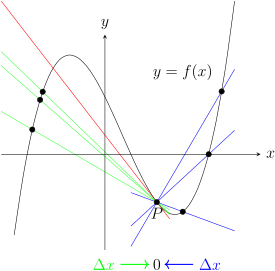
Secant is a Latin word meaning to cut, and in mathematics a secant line cuts an arbitrary bend described by \(y = f(ten)\) through two points \(P\) and \(Q\text{.}\) The figure shows two such secant lines of the bend \(f\) to the correct and to the left of the bespeak \(P\text{,}\) respectively.
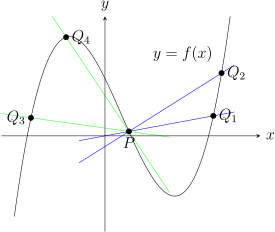
Since past necessity the secant line goes through two points on the curve of \(y = f(ten)\text{,}\) nosotros tin can readily calculate the slope of this secant line.
Definition 4.1. Slope of Secant Line — Average Rate of Change.
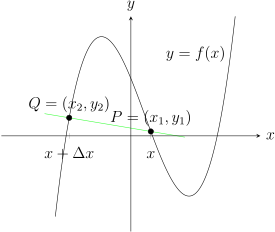
Suppose we are given two points \(\left(x_{1},y_{1}\right)\) and \(\left(x_{ii},y_{2}\right)\) on the secant line of the bend described by the part \(y = f(10)\) as shown. Then the slope of the secant line is calculated by
\begin{equation*} 1000 = \dfrac{\Delta y}{\Delta x} = \dfrac{y_{two}-y_{ane}}{x_{ii}-x_{1}}\text{.} \end{equation*}
Note that we may also exist given the modify in \(ten\) directly every bit \(\Delta 10\text{,}\) i.e the two points are given as \(\left(x,f(10)\right)\) and \(\left(x+\Delta ten, f(10 + \Delta x)\right)\text{,}\) and then
\begin{equation*} grand = \dfrac{\Delta y}{\Delta x} = \dfrac{f(x + \Delta 10)-f(ten)}{\Delta x}\text{.} \end{equation*}
Note:
-
In the to a higher place figure, the value of \(\Delta x\) must exist negative since it is on the left side of \(x\text{.}\)
-
The slope of the secant line is as well referred to as the average rate of change of \(f\) over the interval \(\left[x,ten+\Delta ten\right]\text{.}\)
-
The expression \(\dfrac{f(x + \Delta x) - f(x)}{\Delta x}\) is referred to as the departure quotient.
Tangent Line.
Tangent is a Latin word significant to touch, and in mathematics a tangent line touches an arbitrary bend described by \(y = f(ten)\) at a betoken \(P\) but non any other points nearby equally shown.
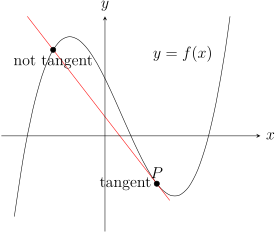
Since by definition the tangent line only touches one point on the curve of \(y = f(ten)\text{,}\) we cannot calculate the slope of this tangent line with our slope formula for a line. In fact, up to now, we practice not have any way of calculating this slope unless nosotros are able to employ some geometry.
Suppose that \(y\) is a function of \(x\text{,}\) say \(y = f(x)\text{.}\) Since information technology is often useful to know how sensitive the value of \(y\) is to small changes in \(x\text{,}\) let's explore this concept via an example, and see how this will inform us near the adding of the slope of the tangent line.
Case 4.2. Small Changes in \(x\).
Consider \(\ds y=f(x)=\sqrt{625-ten^2}\) (the upper semicircle of radius 25 centered at the origin), and allow's compute the changes of \(y\) resulting from small changes of \(10\) around \(x=7\text{.}\)
Solution
When \(10=7\text{,}\) we notice that \(\ds y=\sqrt{625-49}=24\text{.}\) Suppose we desire to know how much \(y\) changes when \(10\) increases a little, say to 7.1 or 7.01.
Let us wait at the ratio \(\Delta y/\Delta 10\) for our function \(\ds y=f(ten)=\sqrt{625-x^2}\) when \(ten\) changes from 7 to \(7.1\text{.}\) Here \(\Delta x=seven.i-7=0.i\) is the modify in \(ten\text{,}\) and
\brainstorm{marshal*} \Delta y =f(10+\Delta x)-f(x)\amp =f(7.1)-f(7)\\ \amp =\sqrt{625-7.i^ii}-\sqrt{625-7^two}\\ \amp \approx 23.9706-24=-0.0294\text{.} \end{align*}
Thus, \(\Delta y/\Delta x\approx -0.0294/0.1=-0.294\text{.}\) This means that \(y\) changes by less than one 3rd the alter in \(x\text{,}\) and so apparently \(y\) is non very sensitive to changes in \(x\) at \(x=seven\text{.}\) Nosotros say "apparently" hither considering we don't really know what happens between 7 and value at \(7\text{.}\) This is not in fact the case for this detail office, just we don't yet know why.
The quantity \(\Delta y/\Delta x\approx -0.294\) may exist interpreted as the gradient of the secant line through \((seven,24)\) and \((7.1,23.9706)\text{.}\) In general, if we draw the secant line from the betoken \((seven,24)\) to a nearby signal on the semicircle \((7+\Delta x,\,f(seven+\Delta 10))\text{,}\) the slope of this secant line is the so-called difference quotient
\begin{equation*} \frac{f(7+\Delta x)-f(7)}{\Delta x}= \frac{\sqrt{625-(vii+\Delta x)^2}-24}{\Delta ten}\text{.} \end{equation*}
For example, if \(x\) changes simply from vii to 7.01, so the difference quotient (slope of the secant line) is approximately equal to \((23.997081-24)/0.01=-0.2919\text{.}\) This is slightly dissimilar than for the secant line from \((seven,24)\) to \((7.1,23.9706)\text{.}\)
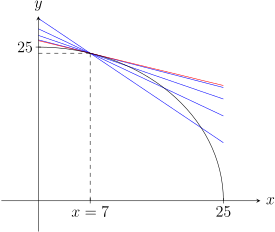
Equally \(\Delta x\) is made smaller (closer to 0), \(seven+\Delta x\) gets closer to 7 and the secant line joining \((vii,f(7))\) to \((7+\Delta x,f(7+\Delta x))\) shifts slightly, every bit shown in Figure 4.1. The secant line gets closer and closer to the tangent line to the circumvolve at the indicate \((7,24)\text{.}\) (The tangent line is the line that just grazes the circumvolve at that betoken, i.due east., it doesn't meet the circle at whatsoever second point.) Thus, equally \(\Delta 10\) gets smaller and smaller, the gradient \(\Delta y/\Delta 10\) of the secant line gets closer and closer to the gradient of the tangent line. This is actually quite hard to see when \(\Delta x\) is small, because of the scale of the graph. The values of \(\Delta x\) used for the effigy are \(1\text{,}\) \(v\text{,}\) \(10\) and \(15\text{,}\) not really very small-scale values. The tangent line is the ane that is uppermost at the right manus endpoint.
Then far nosotros take establish the slopes of two secant lines that should be shut to the slope of the tangent line, but what is the slope of the tangent line exactly? Since the tangent line touches the circle at only one point, we will never exist able to calculate its slope straight, using ii "known" points on the line. What we demand is a style to capture what happens to the slopes of the secant lines as they get "closer and closer" to the tangent line.
Instead of looking at more item values of \(\Delta x\text{,}\) allow's encounter what happens if nosotros do some algebra with the divergence caliber using but \(\Delta x\text{.}\) The slope of a secant line from \((vii,24)\) to a nearby point \(\left(seven+\Delta x,f(vii+\Delta ten)\right)\) is given past
\brainstorm{align*} \frac{f(vii+\Delta x)-f(7)}{\Delta x}\amp =\frac{\sqrt{625-(seven+\Delta x)^2} - 24}{\Delta x}\\ \amp = \left( \ds\frac{\sqrt{625-(7+\Delta x)^2} - 24}{\Delta x} \correct) \left(\frac{\sqrt{625-(seven+\Delta ten)^2}+24}{\sqrt{625-(seven+\Delta x)^2}+24} \right)\\ \amp =\frac{625-(7+\Delta ten)^2-24^ii}{\Delta x(\sqrt{625-(7+\Delta x)^2}+24)}\\ \amp =\frac{49-49-xiv\Delta 10-\Delta x^2}{\Delta x(\sqrt{625-(7+\Delta 10)^two}+24)}\\ \amp =\frac{625-(vii+\Delta x)^2-24^ii}{\Delta 10(\sqrt{625-(7+\Delta x)^ii}+24)}\\ \amp =\frac{49-49-14\Delta x-\Delta x^2}{\Delta x(\sqrt{625-(seven+\Delta ten)^ii}+24)}\\ \amp =\frac{\Delta x(-14-\Delta x)}{\Delta x(\sqrt{625-(7+\Delta ten)^ii}+24)}\\ \amp =\frac{-fourteen-\Delta x}{\sqrt{625-(7+\Delta x)^2}+24} \cease{align*}
At present, can we tell by looking at this terminal formula what happens when \(\Delta x\) gets very close to cypher? The numerator clearly gets very close to \(-14\) while the denominator gets very close to \(\ds \sqrt{625-vii^2}+24=48\text{.}\) The fraction is therefore very close to \(-14/48 = -7/24 \cong -0.29167\text{.}\) In fact, the slope of the tangent line is exactly \(-7/24\text{.}\)
What about the slope of the tangent line at \(x=12\text{?}\) Well, 12 tin can't be all that different from vii; we just have to redo the calculation with 12 instead of 7. This won't be hard, but it will be a bit wearisome. What if we endeavour to do all the algebra without using a specific value for \(x\text{?}\) Allow's copy from higher up, replacing seven by \(x\text{.}\)
\begin{marshal*} \frac{f(x+\Delta x)-f(ten)}{\Delta 10}\amp =\frac{\sqrt{625-(ten+\Delta x)^ii} - \sqrt{625-x^2}}{\Delta x}\\ \amp =\frac{\sqrt{625-(10+\Delta x)^2} - \sqrt{625-x^2}}{\Delta x} \frac{\sqrt{625-(x+\Delta x)^ii}+\sqrt{625-x^ii}}{\sqrt{625-(ten+\Delta x)^2}+\sqrt{625-ten^2}}\\ \amp =\frac{625-(x+\Delta x)^two-625+x^2}{\Delta x(\sqrt{625-(x+\Delta ten)^two}+\sqrt{625-x^ii})}\\ \amp =\frac{625-x^2-2x\Delta x-\Delta ten^ii-625+ten^two}{\Delta x(\sqrt{625-(10+\Delta x)^2}+\sqrt{625-x^2})}\\ \amp =\frac{\Delta 10(-2x-\Delta x)}{\Delta x(\sqrt{625-(ten+\Delta ten)^2}+\sqrt{625-10^2})}\\ \amp =\frac{-2x-\Delta ten}{\sqrt{625-(10+\Delta x)^2}+\sqrt{625-x^two}} \end{align*}
At present what happens when \(\Delta ten\) is very close to zero? Once again it seems apparent that the quotient will be very close to
\begin{equation*} \frac{-2x}{\sqrt{625-10^2}+\sqrt{625-x^2}} =\frac{-2x}{2\sqrt{625-x^2}}=\frac{-ten}{\sqrt{625-x^ii}}\text{.} \finish{equation*}
Replacing \(ten\) by seven gives \(-7/24\text{,}\) as before, and now we can hands do the computation for 12 or any other value of \(10\) between \(-25\) and 25.
And so now we have a unmarried expression, \(\ds \dfrac{-x}{\sqrt{625-10^2}}\text{,}\) that tells us the slope of the tangent line for any value of \(ten\text{.}\) This slope, in plow, tells us how sensitive the value of \(y\) is to small changes in the value of \(10\text{.}\)
To summarize, we computed the slope of the tangent line at a signal \(P = \left(10, f(10)\right)\) on the curve of a function \(y = f(ten)\) past forming the divergence quotient and figuring out what happens when \(\Delta ten\) gets very close to \(0\text{.}\) At this betoken, we should notation that the idea of letting go closer and closer to \(0\) is precisely the idea of a limit that we discussed in the last chapter. This leads us to the following definition.
Definition 4.3. Slope of Tangent Line—Instantaneous Rate of Modify.
The slope of the tangent line to the graph of a function \(y = f(ten)\) at the point \(P = \left(x,f(x)\correct)\) is given by
\begin{equation*} one thousand = \lim_{\Delta x \to 0} \dfrac{f(x + \Delta x)-f(ten)}{\Delta 10}\text{,} \terminate{equation*}
provided this limit exists.
The expression\(\ds \dfrac{-x}{\sqrt{625-x^2}}\) defines a new part chosen the derivative (run into Section 4.2) of the original office (since information technology is derived from the original function). If the original is referred to equally \(f\) or \(y\) and then the derivative is ofttimes written as \(f'\) or \(y'\text{,}\) read "f prime" or "y prime number". We also write
\begin{equation*} f'(10)=\dfrac{-x}{\sqrt{625-x^2}} \text{ or } y'=\ds \dfrac{-ten}{\sqrt{625-x^2}}\text{.} \terminate{equation*}
At a item bespeak, say \(x=7\text{,}\) we write \(f'(7)=-7/24\) and we say that "\(f\) prime of 7 is \(-seven/24\)" or "the derivative of \(f\) at 7 is \(-7/24\text{.}\)"
In the particular case of a circle, there's a elementary way to find the derivative. Since the tangent to a circumvolve at a bespeak is perpendicular to the radius drawn to the point of contact, its gradient is the negative reciprocal of the slope of the radius. The radius joining \((0,0)\) to \((vii,24)\) has slope 24/7. Hence, the tangent line has gradient \(-7/24\text{.}\) In general, a radius to the point \(\ds (x,\sqrt{625-10^ii})\) has gradient \(\ds \sqrt{625-ten^ii}/x\text{,}\) so the slope of the tangent line is \(\ds {-ten/ \sqrt{625-10^2}}\text{,}\) as before. It is Non always true that a tangent line is perpendicular to a line from the origin—don't apply this shortcut in any other circumstance.
We at present summarize our findings.
From Tangent Line Gradient to Derivative.
Given a role \(f\) and a bespeak \(10\) we can compute the derivative of \(f(x)\) at \(x\) as follows:
-
Form the divergence quotient \(\dfrac{f(x+\Delta x)-f(x)}{\Delta x}\text{,}\) which is the slope of a general secant line of the curve \(f\) throught the points \(P = \left(10,f(x)\correct)\) and \(Q = \left(ten+\Delta x, f(x+\Delta x)\right)\text{.}\)
-
Have the limits equally \(\Delta ten\) goes to zilch: \(\lim\limits_{\Delta x \to 0} \dfrac{f(ten+\Delta x)-f(10)}{\Delta x}\text{,}\) which is the slope of the tangent line of the curve \(f\) at the point \(P = \left(ten,f(x)\right)\text{.}\)
-
If this limit exists, and so the derivative exists and is equal to this limit.
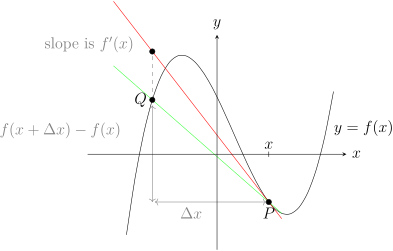
In other words,
\brainstorm{equation*} f'(ten)=\lim\limits_{\Delta x \to 0} \dfrac{f(ten+\Delta 10)-f(x)}{\Delta ten}\text{,} \terminate{equation*}
provided the limit exists.
Interactive Demonstration. Use the sliders below to investigate the limit of secant lines (blue and light-green) as they approach the tangent line (red) to any point \(P \) on the graph:
Subsection four.1.1 Applications
¶We started this department past saying, "It is frequently useful to know how sensitive the value of \(y\) is to minor changes in \(10\text{.}\)" Nosotros have seen one purely mathematical example of this, involving the function \(f(ten)=\sqrt{625-10^2}\text{.}\) Here are some more practical examples.
With conscientious measurement it might be possible to discover that the elevation of a dropped ball \(t\) seconds afterward it is released is \(\ds h(t)=h_0-kt^2\text{.}\) (Hither \(h_0\) is the initial height of the brawl, when \(t=0\text{,}\) and \(grand\) is some number adamant by the experiment.) A natural question is and then, "How fast is the ball going at fourth dimension \(t\text{?}\)" We can certainly get a pretty good idea with a little elementary arithmetics.
Case 4.4. Analyzing Velocity.
Suppose that the height \(h\) in metres of a dropped ball \(t\) seconds after it is released is given by
\begin{equation*} h(t) = h_{0} - kt^{2} \terminate{equation*}
with \(h_{0} = 100\) g and \(k = iv.9\text{.}\) We will reply the question "How fast is the brawl travelling at time \(t = 2\text{?}\)" by exploring boilerplate speed near time \(t = 2\) and discussing the difference betwixt speed and velocity.
Solution
We know that when \(t=2\) the pinnacle is \(100-iv\cdot 4.9=eighty.iv\) metres. A 2d later, at \(t=three\text{,}\) the height is \(100-9\cdot iv.ix=55.9\) metres. The modify in height during that second is \(55.9-80.iv=-24.5\) metres. The negative sign means the height has decreased, as we expect for a falling ball, and the number 24.5 is the boilerplate speed of the ball during the time interval, in metres per 2nd.
We might guess that 24.five metres per second is not a terrible gauge of the speed at \(t=2\text{,}\) but certainly we can do better. At \(t=2.five\) the height is \(\ds 100-4.9(2.v)^2=69.375\) metres. During the half 2d from \(t=ii\) to \(t=two.5\text{,}\) the change in superlative is \(69.375-80.4=-xi.025\) metres giving an average speed of \(11.025/(ane/2)=22.05\) metres per 2nd. This should exist a meliorate estimate of the speed at \(t=2\text{.}\) So information technology's articulate now how to get amend and better approximations: compute average speeds over shorter and shorter time intervals. Betwixt \(t=2\) and \(t=2.01\text{,}\) for example, the ball drops 0.19649 metres in one hundredth of a second, at an boilerplate speed of 19.649 metres per second.
We still might reasonably ask for the precise speed at \(t=2\) (the instantaneous speed) rather than just an approximation to information technology. For this, in one case over again, we need a limit. Allow'south calculate the average speed during the time interval from \(t=2\) to \(t=two+\Delta t\) without specifying a particular value for \(\Delta t\text{.}\) The change in elevation during the fourth dimension interval from \(t=ii\) to \(t=2+\Delta t\) is
\begin{align*} h(2+\Delta t)-h(2) \amp =(100-4.9(2+\Delta t)^2)-80.4\\ \amp =100-4.9(four+4\Delta t+\Delta t^two)-80.4\\ \amp =100-nineteen.6-19.half dozen\Delta t-iv.nine\Delta t^ii-80.4\\ \amp =-19.6\Delta t-4.9\Delta t^2\\ \amp =-\Delta t(nineteen.6+4.ix\Delta t) \end{align*}
The average speed during this fourth dimension interval is then
\brainstorm{equation*} \frac{\Delta t(xix.6+4.nine\Delta t)}{\Delta t}=19.vi+4.9\Delta t\text{.} \end{equation*}
When \(\Delta t\) is very small, this is very close to 19.six. Indeed, \(\lim\limits_{\Delta t\to 0}\left(19.6+4.9\Delta t\correct)=nineteen.six\text{.}\) And then the exact speed at \(t=2\) is 19.6 metres per second.
At this stage we need to make a distinction betwixt speed and velocity. Velocity is signed speed, that is, speed with a direction indicated by a sign (positive or negative). Our algebra above actually told us that the instantaneous velocity of the ball at \(t=2\) is \(-19.6\) metres per second. The number 19.6 is the speed and the negative sign indicates that the movement is directed downwards (the direction of decreasing height).
In the language of the previous section, nosotros might accept started with \(\ds f(x)=100-four.9x^ii\) and asked for the slope of the tangent line at \(x=ii\text{.}\) We would take answered that question by computing
\brainstorm{equation*} \brainstorm{split up} \lim_{\Delta x\to 0}\frac{f(2+\Delta x) - f(two)}{\Delta ten} \amp=\lim_{\Delta 10\to 0}\frac{-xix.6\Delta x-four.9\Delta x^ii}{\Delta x}\\ \amp=\lim_{\Delta x\to 0} \left(-nineteen.half-dozen-iv.9\Delta x\right)=-19.6 \end{separate} \end{equation*}
The algebra is the same. Thus, the velocity of the brawl is the value of the derivative of a sure function, namely, of the function that gives the position of the brawl.
The upshot is that this trouble, finding the velocity of the ball, is exactly the aforementioned problem mathematically as finding the slope of a bend. This may already be enough evidence to convince you that whenever some quantity is changing (the meridian of a curve or the peak of a ball or the size of the economic system or the altitude of a space probe from earth or the population of the earth) the rate at which the quantity is changing tin, in principle, exist computed in exactly the aforementioned way, past finding a derivative.
Example 4.5. Demand for Sweaters.
A clothing manufacturer has determined that the weekly demand office of their sweaters is given by
\brainstorm{equation*} p = f(q) = 144-q^{ii} \end{equation*}
where \(p\) is measured in dollars and \(q\) is measured in units of a thousand. Find the average rate of change in the unit price of a sweater if the quantity demanded is betwixt \(5000\) and \(6000\) sweaters, between \(5000\) and \(5100\) sweaters, and betwixt \(5000\) and \(5010\) sweaters. What is the instantaneous rate of change of the unit price when the quantity demanded is \(5000\) units?
Solution
The average rate of change of the unit of measurement price of a sweater if the quantity demanded is betwixt \(q\) and \(q + \Delta q\) is
\begin{equation*} \brainstorm{split up} \dfrac{f(q+\Delta q)-f(q)}{\Delta q} \amp = \dfrac{\left(144 - (q+\Delta q)^{2}\correct) - \left(144 - q^{ii}\right)}{\Delta q} \\ \amp = \dfrac{144 - q^{2} - 2q\Delta q - \Delta q^{ii} - 144 + q^{2}}{\Delta q} \\ \amp = -2q - \Delta q \stop{split} \stop{equation*}
To notice the average rate of change of the unit price of a sweater when the quantity demanded is between \(5000\) and \(6000\) sweaters (that is, over the interval \(\left[5,six\correct]\)), we take \(q = 5\) and \(\Delta q = ane\text{,}\) obtaining
\brainstorm{equation*} -2(5)-1 = -11 \end{equation*}
or -$\(11\) per \(1000\) sweaters. Similarly, taking \(\Delta q = 0.1\) and \(\Delta q = 0.01\) with \(q=5\text{,}\) we notice that the average rates of change of the unit price when the quantities demanded are between \(5000\) and \(5100\) and betwixt \(5000\) and \(5010\) are -$\(10.ten\) and -$\(10.01\) per \(1000\) sweaters, respectively.
The instantaneous rate of change of the unit price of a sweater when the quantity demanded is \(q\) units is given by
\brainstorm{equation*} \brainstorm{split} \lim_{\Delta q\to 0} \dfrac{f(q+\Delta q)-f(q)}{\Delta q} \amp = \lim_{\Delta q \to 0} \dfrac{\left(144 - (q+\Delta q)^{two}\right) - \left(144 - q^{2}\right)}{\Delta q} \\ \amp = \lim_{\Delta q \to 0} \left(-2q - \Delta q\right) \\ \amp = -2q \end{split} \end{equation*}
In item, the instantaneous charge per unit of change when the quantity demanded is \(5000\) sweaters is
\begin{equation*} -2(5) = -10 \end{equation*}
or -$\(ten\) per \(one thousand\) sweaters.
Exercises for Section 4.1.
Exercise iv.i.1.
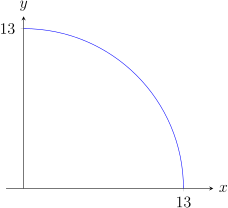
Describe the graph of the role \(\ds y=f(ten)=\sqrt{169-x^two}\) between \(x=0\) and \(ten=13\text{.}\) Find the slope \(\Delta y/\Delta x\) of the secant line between the points of the circle lying over (a) \(x=12\) and \(x=xiii\text{,}\) (b) \(x=12\) and \(10=12.ane\text{,}\) (c) \(ten=12\) and \(x=12.01\text{,}\) (d) \(x=12\) and \(ten=12.001\text{.}\) At present employ the geometry of tangent lines on a circle to detect (e) the exact value of the derivative \(f'(12)\text{.}\) Your answers to (a)–(d) should be getting closer and closer to your answer to (e).
Answer\(-v\text{,}\) \(-2.47106145\text{,}\) \(-2.4067927\text{,}\) \(-two.400676\text{,}\) \(-two.4\)
The graph of \(y=f(10)=\sqrt{169-x^ii}\) is a semi-circumvolve of radius xiii. Nosotros plot \(f(ten)\) beneath on the interval \([0,13]\text{:}\)
Nosotros wish to estimate \(f'(12)\) first using secant lines. Therefore, nosotros ready the deviation caliber at \(ten=12\text{:}\)
\begin{equation*} \frac{\Delta y}{\Delta x} = \frac{f(12+\Delta x) - f(12)}{\Delta x} = \frac{\sqrt{162-(12+\Delta x)^2} - 5}{\Delta x} \end{equation*}
-
The slope of the secant line betwixt \(x=12\) and \(x=13\) (\(\Delta ten = 1\)) is given by
\begin{equation*} \frac{\Delta y}{\Delta x} = \frac{0-5}{1} = -five\text{.} \end{equation*}
-
The slope of the secant line between \(x=12\) and \(x=12.1\) (\(\Delta x = 0.i\)) is given past
\brainstorm{equation*} \frac{\Delta y}{\Delta ten} \approx \frac{4.75289 - v}{0.ane} = -2.471\text{.} \finish{equation*}
-
The slope of the secant line between \(x=12\) and \(x=12.01\) (\(\Delta x = 0.01\)) is given by
\begin{equation*} \frac{\Delta y}{\Delta x} \approx \frac{4.97593 - 5}{0.01} = -two.407\text{.} \end{equation*}
-
A property of circles is that the tangent line at any betoken on the circle is perpendicular the the line connecting that point to the centre of the circumvolve (in this case, the origin):
The slope of the line connecting the betoken \((12,5)\) to the origin is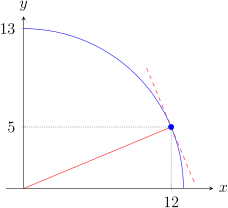
\begin{equation*} \frac{\Delta y}{\Delta x} = \frac{five-0}{12 - 0} = \frac{five}{12}\text{.} \finish{equation*}
Hence, the slope of the tangent line at \(x=12\) must be
\begin{equation*} -\frac{1}{\frac{5}{12}} = -\frac{12}{five} = 2.4\text{.} \end{equation*}
We further detect that our answers to parts (a)-(d) are getting closer and closer to this value. Hence, \(f'(12) = 2.4\text{.}\)
Exercise 4.1.2.
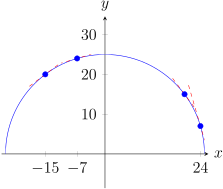
Use geometry to find the derivative \(f'(x)\) of the role \(\ds f(x)=\sqrt{625-x^two}\) in the text for each of the post-obit \(x\text{:}\) (a) 20, (b) 24, (c) \(-vii\text{,}\) (d) \(-15\text{.}\) Draw a graph of the upper semicircle, and draw the tangent line at each of these four points.
Answer\(-4/iii\text{,}\) \(-24/7\text{,}\) \(seven/24\text{,}\) \(3/4\)
The graph of \(y=f(x)=\sqrt{625-ten^two}\) is a semi-circle of radius 25. We plot \(f(x)\) below on the interval \([-25,25]\text{:}\)
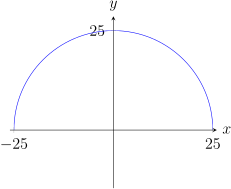
Nosotros will use the fact that the tangent line at any betoken on the circle is perpendicular the the line connecting that point to the eye of the circle. For whatever point \((ten, y) = (x, \sqrt{625-ten^2})\text{,}\) the slope of the line connecting the origin to the bespeak is given by
\begin{equation*} \frac{\Delta y}{\Delta x} = \frac{\sqrt{625-x^2}}{10}\text{,} \end{equation*}
and so the slope of the tangent line at this signal must be the reciprocal of this value:
\brainstorm{equation*} f'(x) = - \frac{x}{\sqrt{625-10^2}} \end{equation*}
-
At \(ten=xx\text{,}\) we have
\begin{equation*} f'(xx) = - \frac{20}{\sqrt{625-twenty^ii}} = -\frac{20}{15} = -\frac{iv}{3}\text{.} \end{equation*}
-
At \(x=24\text{,}\) we accept
\begin{equation*} f'(24) = - \frac{24}{\sqrt{625-24^2}} = -\frac{24}{7}\text{.} \end{equation*}
-
At \(ten=-seven\text{,}\) we have
\begin{equation*} f'(-vii) = -\frac{-seven}{\sqrt{625-(-7)^ii}} = \frac{vii}{24}\text{.} \end{equation*}
-
At \(x=-15\text{,}\) nosotros have
\begin{equation*} f'(-fifteen) = -\frac{-fifteen}{\sqrt{625-(-15)^2}} = \frac{15}{20} = \frac{3}{four}\text{.} \end{equation*}
We illustrate with the following graph.
Exercise 4.1.iii.
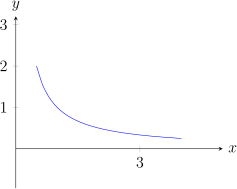
Draw the graph of the function \(y=f(10)=ane/x\) between \(x=i/two\) and \(x=4\text{.}\) Find the slope of the secant line betwixt (a) \(x=3\) and \(x=iii.one\text{,}\) (b) \(x=3\) and \(x=iii.01\text{,}\) (c) \(x=3\) and \(x=3.001\text{.}\) Now apply algebra to find a uncomplicated formula for the gradient of the secant line between \((3,f(iii))\) and \((iii+\Delta x,f(3+\Delta 10))\text{.}\) Make up one's mind what happens when \(\Delta x\) approaches 0. In your graph of \(y=1/x\text{,}\) draw the direct line through the point \((3,ane/3)\) whose slope is this limiting value of the difference quotient every bit \(\Delta 10\) approaches 0.
Answer\(-0.107526881\text{,}\) \(-0.11074197\text{,}\) \(-0.1110741\text{,}\) \(\ds{-ane\over3(3+\Delta x)}\rightarrow {-i\over9}\)
We plot the graph of \(y = f(ten) = 1/ten\) over the interval \([0.5,4]\) below.
We first construct the difference caliber at \(x=iii\text{:}\)
\begin{equation*} \begin{split} \frac{\Delta y}{\Delta ten} \amp = \frac{f(3 + \Delta ten) - f(3)}{\Delta x} \\ \amp = \frac{\frac{1}{3+ \Delta x} - \frac{1}{3}}{\Delta ten} \\ \amp = \frac{\frac{iii - (3+\Delta x)}{3(3+\Delta ten)}}{\Delta x} \\ \amp = -\frac{ane}{3(3+\Delta ten)} \end{split} \cease{equation*}
We use this difference quotient to compute the following.
-
The gradient of the secant line between \(x=3\) and \(x=3.ane\) (\(\Delta ten = 0.i\)) is
\brainstorm{equation*} \frac{\Delta y}{\Delta x} = -\frac{1}{3(3+0.1)} \approx 0.1075\text{.} \end{equation*}
-
The slope of the secant line between \(x=iii\) and \(x=iii.01\) (\(\Delta ten = 0.01\)) is
\begin{equation*} \frac{\Delta y}{\Delta ten} = -\frac{1}{three(three+0.01)} \approx 0.1107\text{.} \end{equation*}
-
The slope of the secant line between \(10=iii\) and \(x=3.001\) (\(\Delta ten = 0.01\)) is
\brainstorm{equation*} \frac{\Delta y}{\Delta ten} = -\frac{1}{iii(3+0.001)} \approx 0.1111\text{.} \stop{equation*}
Every bit \(\Delta ten \to 0\text{,}\) nosotros encounter that the slope of the secant line betwixt \((3,f(3))\) and \((3+\Delta ten, f(3+\Delta x)\) becomes
\begin{equation*} \lim_{\Delta ten \to 0} \frac{-1}{three(3+\Delta 10)} = -\frac{ane}{three(iii+0)} = -\frac{ane}{9}\text{.} \finish{equation*}
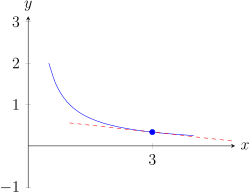
The equation of the line which passes through the signal \((3,f(3)) = (3, 1/3)\) and has gradient \(-1/9\) is
\begin{equation*} y - \frac{1}{3} = -\frac{i}{ix} (10-3)\text{.} \end{equation*}
This is the equation of the tangent line at \(10=3\text{,}\) shown below.
Exercise 4.1.four.
Find an algebraic expression for the departure caliber \(\ds \bigl(f(ane+\Delta x)-f(1)\bigr)/\Delta x\) when \(\ds f(x)=x^2-(1/ten)\text{.}\) Simplify the expression equally much every bit possible. Then determine what happens every bit \(\Delta x\) approaches 0. That value is \(f'(1)\text{.}\)
Answer\(\ds{3+3\Delta ten+\Delta x^2\over1+\Delta 10}\rightarrow3\)
The difference quotient for \(f(x) = ten^2 - \frac{ane}{x}\) is:
\begin{equation*} \brainstorm{split} \frac{f(ten+\Delta x) - f(x)}{\Delta x} \amp = \frac{1}{\Delta x} \left((x+\Delta x)^2 - \frac{1}{x+\Delta ten} - \left(x^2 - \frac{1}{ten}\correct)\right) \\ \amp = \frac{i}{\Delta ten} \left( x^two + 2x\Delta x + \Delta x^2 - \frac{1}{x+\Delta ten} - 10^2 + \frac{i}{10} \right)\\ \amp = \frac{one}{\Delta x} \left(2x\Delta x + \Delta x^2 + \frac{- x + (x + \Delta ten)}{x(x+\Delta x)}\correct) \\ \amp = 2x + \Delta ten + \frac{1}{x(ten+\Delta x)} \cease{carve up} \cease{equation*}
Therefore, at \(ten=1\text{,}\) we have
\begin{equation*} \frac{f(1+\Delta 10) - f(one)}{\Delta x} = ii + \Delta x + \frac{1}{i+\Delta x} = \frac{three + 3\Delta 10 + \Delta ten^2}{1+\Delta x}\text{.} \end{equation*}
Taking the limit as \(\Delta x \to 0\text{,}\) we discover that
\begin{equation*} f'(one) = \lim_{\Delta x \to 0} \frac{3 + 3\Delta 10 + \Delta ten^two}{1+\Delta x} = \frac{3+0+0}{1+0} = 3\text{.} \end{equation*}
Exercise 4.1.5.
Depict the graph of \(\ds y=f(10)=x^3\) betwixt \(x=0\) and \(x=1.v\text{.}\) Observe the slope of the secant line between (a) \(ten=ane\) and \(x=1.1\text{,}\) (b) \(x=ane\) and \(10=1.001\text{,}\) (c) \(x=1\) and \(x=one.00001\text{.}\) Then use algebra to notice a simple formula for the gradient of the secant line betwixt \(1\) and \(1+\Delta x\text{.}\) (Employ the expansion \(\ds (A+B)^3=A^3+3A^2B+3AB^2+B^3\text{.}\)) Determine what happens as \(\Delta x\) approaches 0, and in your graph of \(\ds y=10^iii\) draw the straight line through the point \((1,1)\) whose slope is equal to the value you just found.
Answer\(3.31\text{,}\) \(3.003001\text{,}\) \(iii.0000\text{,}\) \(3+iii\Delta ten+\Delta x^2\rightarrow3\)
We plot the graph of \(y=f(x) = x^three\) on the interval \([0,i.5]\) beneath.
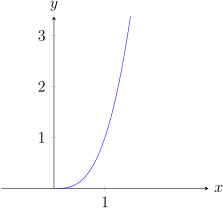
-
The slope of the secant line between \(x=ane\) and \(ten=1.one\) (\(\Delta x = 0.i\))is
\brainstorm{equation*} \frac{\Delta y}{\Delta x} = \frac{f(1.1)-f(1)}{0.ane} = 3.31\text{.} \end{equation*}
-
The gradient of the secant line between \(x=1\) and \(x=ane.001\) (\(\Delta x = 0.001\))is
\brainstorm{equation*} \frac{\Delta y}{\Delta x} = \frac{f(1.001)-f(1)}{0.i} = 3.003001\text{.} \end{equation*}
-
The slope of the secant line between \(10=ane\) and \(x=one.00001\) (\(\Delta 10 = 0.00001\))is
\begin{equation*} \frac{\Delta y}{\Delta x} = \frac{f(ane.00001)-f(one)}{0.i} = three.0000300001\text{.} \finish{equation*}
We now simplify the difference quotient at \(x=1\text{:}\)
\begin{equation*} \begin{split} \frac{f(i+\Delta x) - f(1)}{\Delta x} \amp = \frac{(1+\Delta x)^3 - 1}{\Delta ten} \\ \amp = \frac{1 + 3\Delta 10^2 +3\Delta ten + \Delta 10^iii - ane}{\Delta 10}\\ \amp = three\Delta x + 3 + \Delta x^2 \end{carve up} \stop{equation*}
Therefore, equally \(\Delta 10 \to 0\text{,}\)
\begin{equation*} f'(1) = \lim_{\Delta 10 \to 0} \left( 3\Delta ten + 3 + \Delta x^2\right) = 3\text{.} \terminate{equation*}
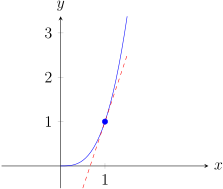
The line with slope \(three\) which passes through the point \((1,f(1)) = (1,1)\) is
\begin{equation*} y - 1 = 3(10-1)\text{.} \end{equation*}
This is the tangent line to \(f\) at \(x=one\text{:}\)
Practice 4.i.6.
Find an algebraic expression for the divergence caliber \((f(x+\Delta x)-f(x))/\Delta x\) when \(f(x)=mx+b\text{.}\) Simplify the expression as much as possible. Then determine what happens as \(\Delta ten\) approaches 0. That value is \(f'(ten)\text{.}\)
Reply SolutionLet \(f(x) = mx+b\text{.}\) The difference quotient is so
\begin{equation*} \begin{split} \dfrac{f(x+\Delta x) - f(ten)}{\Delta x} \amp = \dfrac{m(x+\Delta x) + b - mx - b}{\Delta x} \amp = \dfrac{k\Delta x}{\Delta x} \amp = m \end{split} \terminate{equation*}
Therefore,
\brainstorm{equation*} f'(x) = \lim\limits_{\Delta 10 \to 0} chiliad = one thousand\text{.} \end{equation*}
Exercise 4.one.7.
Sketch the unit circumvolve. Talk over the beliefs of the slope of the tangent line at various angles effectually the circle. Which trigonometric function gives the slope of the tangent line at an angle \(\theta\text{?}\) Why? Hint
Retrieve in terms of ratios of sides of triangles.
We consider the post-obit diagram of the unit of measurement circumvolve and some \(\theta \in [0,\pi]\text{:}\)
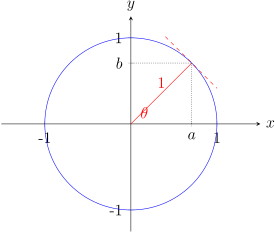
The betoken \((a,b)\) is then given by \((\cos(\theta), \sin(\theta))\text{.}\) And and so the slope of the line connecting the origin to this point is
\brainstorm{equation*} \frac{\Delta y}{\Delta x} = \frac{\cos(\theta)}{\sin(\theta)}\text{.} \end{equation*}
Now, since the slope of the tangent line \(m\) at the point \((a,b)\) is perpendicular to the slope of the line connecting \((a,b)\) to the origin, we must have
\begin{equation*} m = -\frac{\sin(\theta)}{\cos(\theta)} = - \tan(\theta)\text{.} \stop{equation*}
This holds for any \(\theta \in [0, 2\pi]\text{.}\)
Exercise 4.one.viii.
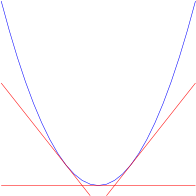
Sketch the parabola \(\ds y=x^two\text{.}\) For what values of \(x\) on the parabola is the gradient of the tangent line positive? Negative? What do you notice about the graph at the point(s) where the sign of the slope changes from positive to negative and vice versa?
SolutionWe see that tangents lines which are tangent to the curve \(y = 10^{2}\) at points \(ten > 0\) have positive slope, and that tangent lines which are tangent to the bend at points \(x \lt 0\) accept negative gradient. Nosotros as well run into that the line tangent to \(10 = 0\) has zero slope, and note that this corresponds to the vertex of the parabola: here, the minimum indicate on the graph.
Exercise four.1.nine.
An object is traveling in a directly line so that its position (that is, distance from some fixed indicate) is given by this table:
| time (s) | 0 | 1 | two | 3 |
| distance (yard) | 0 | 10 | 25 | 60 |
Observe the average speed of the object during the following time intervals: \([0,ane]\text{,}\) \([0,two]\text{,}\) \([0,3]\text{,}\) \([1,2]\text{,}\) \([1,iii]\text{,}\) \([ii,iii]\text{.}\) If yous had to guess the speed at \(t=two\) just on the ground of these, what would you lot approximate?
Answer\(ten\text{,}\) \(25/2\text{,}\) \(20\text{,}\) \(15\text{,}\) \(25\text{,}\) \(35\text{.}\)
Let \(10\) exist the distance travelled in metres and permit \(t\) be the fourth dimension in seconds. And then the average speed of the object over some fourth dimension interval is \(\dfrac{\Delta x}{\Delta t}\text{.}\) Therefore:
-
For \(t \in [0,one]\text{,}\) the boilerplate speed is \(\dfrac{\Delta x}{\Delta t} = \dfrac{10-0}{i-0} = x\) one thousand/due south.
-
For \(t \in [0,2]\text{,}\) the boilerplate speed is \(\dfrac{\Delta x}{\Delta t} = \dfrac{25-0}{2-0} = 12.five\) k/due south.
-
For \(t \in [0,3]\text{,}\) the boilerplate speed is \(\dfrac{\Delta x}{\Delta t} = \dfrac{60-0}{iii-0} = 20\) one thousand/south.
-
For \(t \in [i,two]\text{,}\) the average speed is \(\dfrac{\Delta ten}{\Delta t} = \dfrac{25-10}{2-1} = 15\) g/southward.
-
For \(t \in [1,3]\text{,}\) the average speed is \(\dfrac{\Delta x}{\Delta t} = \dfrac{sixty-10}{3-ane} = 25\) m/s.
-
For \(t \in [2,3]\text{,}\) the average speed is \(\dfrac{\Delta x}{\Delta t} = \dfrac{lx-25}{3-2} = 35\) k/s.
We estimate that the actual speed at \(t=2\) is betwixt 15 and 35 m/s.
Exercise 4.one.x.
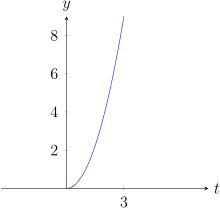
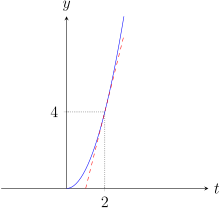
Permit \(\ds y=f(t)=t^two\text{,}\) where \(t\) is the time in seconds and \(y\) is the distance in metres that an object falls on a certain airless planet. Draw a graph of this part betwixt \(t=0\) and \(t=3\text{.}\) Make a tabular array of the boilerplate speed of the falling object between (a) 2 sec and iii sec, (b) 2 sec and 2.1 sec, (c) 2 sec and 2.01 sec, (d) two sec and 2.001 sec. So apply algebra to find a uncomplicated formula for the average speed between time \(two\) and time \(2+ \Delta t\text{.}\) (If you lot substitute \(\Delta t=i, 0.ane, 0.01,0.001\) in this formula you lot should over again get the answers to parts (a)–(d).) Next, in your formula for boilerplate speed (which should be in simplified form) determine what happens equally \(\Delta t\) approaches zero. This is the instantaneous speed. Finally, in your graph of \(\ds y=t^2\) draw the direct line through the point \((ii,4)\) whose slope is the instantaneous velocity you just computed; information technology should of course be the tangent line.
Answer\(v\text{,}\) \(4.1\text{,}\) \(4.01\text{,}\) \(4.001\text{,}\) \(4+\Delta t\rightarrow 4\)
The graph of \(y=f(t)=t^2\) on the interval \([0,iii]\) is shown below, where \(y\) is the distance in metres of a falling object and \(t\) is the time in seconds.
The average speed of the falling object is given by \(\dfrac{\Delta y}{\Delta t}\text{.}\) Therefore:
-
Betwixt \(t=2\) and \(t=3\text{,}\) the average speed is \(\dfrac{\Delta y}{\Delta t} = \dfrac{iii^ii-2^2}{iii-2} = 5\) m/south.
-
Between \(t=two\) and \(t=2.one\text{,}\) the average speed is \(\dfrac{\Delta y}{\Delta t} = \dfrac{2.1^two-2^two}{ii.i-two} = 4.ane\) m/southward.
-
Betwixt \(t=2\) and \(t=2.01\text{,}\) the average speed is \(\dfrac{\Delta y}{\Delta t} = \dfrac{two.01^2-2^two}{3-ii} = 4.01\) thou/south.
-
Betwixt \(t=2\) and \(t=two.001\text{,}\) the average speed is \(\dfrac{\Delta y}{\Delta t} = \dfrac{2.001^two-2^2}{3-2} = 4.001\) m/s.
Our formula for boilerplate speed between \(t=2\) and \(t=2+\Delta t\) can be simplified:
\begin{equation*} \begin{split} \frac{\Delta y}{\Delta t} \amp = \frac{f(2+\Delta t) - f(2)}{\Delta t}\\ \amp = \frac{(2+\Delta t)^2 - 4}{\Delta t}\\ \amp = \frac{(four+iv\Delta t + \Delta t^2) - iv}{\Delta t}\\ \amp = \frac{four\Delta t + \Delta t^2}{\Delta t}\\ \amp = 2t +\Delta t \end{split} \end{equation*}
Therefore, the instantaneous speed is given by
\begin{equation*} \lim_{\Delta t \to 0} \left(4 + \Delta t\correct) = 4\text{.} \terminate{equation*}
And then at \(t=2\text{,}\) the speed is iv m/due south (notice that our answers in (a)-(d) were budgeted this value). The line which passes through the point \((ii,4)\) and has slope \(four\) is given by
\begin{equation*} y - 4 = four(x-2)\text{,} \end{equation*}
and is plotted below. This is the tangent line to \(y\) at \(t=2\text{.}\)
Exercise 4.ane.11.
If an object is dropped from an fourscore-metre loftier window, its tiptop \(y\) above the ground at time \(t\) seconds is given by the formula \(\ds y=f(t)=lxxx-four.9t^2\text{.}\) (Here we are neglecting air resistance.) Find the boilerplate velocity of the falling object betwixt (a) 1 sec and ane.1 sec, (b) 1 sec and i.01 sec, (c) 1 sec and 1.001 sec. Now utilise algebra to find a uncomplicated formula for the average velocity of the falling object between 1 sec and \(i+\Delta t\) sec. Determine what happens to this average velocity as \(\Delta t\) approaches 0. That is the instantaneous velocity at time \(t=1\) second (it will be negative, because the object is falling).
Answer\(-10.29\text{,}\) \(-9.849\text{,}\) \(-9.8049\text{,}\) \(-nine.8-4.9\Delta t\rightarrow -9.viii\)
Allow \(y=f(t)=lxxx-4.9t^2\) be the peak in metres of a falling object in a higher place the footing at time \(t\) seconds.
The average velocity of the falling object is given past \(\dfrac{\Delta y}{\Delta t}\text{.}\) Notice that \(y(ane) = 80-4.nine = 75.i\) m. Therefore:
-
Between \(t=one\) and \(t=1.1\text{,}\) the average speed is \(\dfrac{\Delta y}{\Delta t} = \dfrac{74.071-75.1}{0.1} = -10.29\) m/s.
-
Between \(t=1\) and \(t=one.01\text{,}\) the average speed is \(\dfrac{\Delta y}{\Delta t} = \dfrac{75.00151-75.1}{0.01} = -9.849\) m/s.
-
Betwixt \(t=i\) and \(t=1.001\text{,}\) the average speed is \(\dfrac{\Delta y}{\Delta t} = \dfrac{75.0901951-75.1}{0.001} = -nine.8049\) m/due south.
The formula for boilerplate velocity between \(t=one\) and \(t=ane+\Delta t\) can exist simplified:
\begin{equation*} \brainstorm{split} \frac{\Delta y}{\Delta t} \amp = \frac{f(i+\Delta t) - f(1)}{\Delta t}\\ \amp = \frac{(eighty-4.nine(1+\Delta t)^ii) - (fourscore-4.ix)}{\Delta t}\\ \amp = \frac{80- 4.9(1+2\Delta t + \Delta t^2) - 80 +4.9}{\Delta t}\\ \amp = \frac{-four.9-9.8\Delta t - 4.9\Delta t^ii + 4.9}{\Delta t}\\ \amp = -ix.8 - four.ix\Delta t \end{split} \stop{equation*}
Therefore, the instantaneous velocity is given by
\brainstorm{equation*} \lim_{\Delta t \to 0} \left(-9.8 + 4.9\Delta t\correct) = -9.eight\text{.} \terminate{equation*}
Then at \(t=1\text{,}\) the velocity is -ix.viii one thousand/due south (notice that our answers in (a)-(c) were approaching this value).
Exercise 4.i.12.
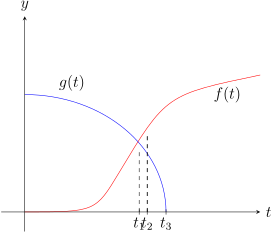
The post-obit figure shows the devastating effect the opening of a new chain java store had on a three-generation rural café in a modest town. The revenue of the chain coffee shop at time \(t\) (in months) is given by \(f(t)\) million dollars, whereas the revenue of the rural café at time \(t\) is given by \(k(t)\) million dollars. Respond the following questions by giving the value of \(t\) at which the specifying event took place.
-
The revenue of the rural café is decreasing at the slowest rate.
Reply -
The revenue of the rural café is decreasing at the fastest rate.
Answer -
The revenue of the chain coffe store first overtakes that of the rural café.
Answer -
The revenue of the chain coffee shop is increasing at the fastest rate.
Answer
Exercise 4.ane.thirteen.
The need office for tires is given by
\begin{equation*} p = f(q) = -0.1q^{2} - q + 125 \finish{equation*}
where \(p\) is measured in dollars and \(q\) is measured in units of a thousand.
-
Find the average charge per unit of modify in the unit price of a tire if the quantity demanded is between \(5000\) and \(5050\) tires; between \(5000\) and \(5010\) tires.
AnswerSolution-$\(2.00\) per \(1000\) tires.
Allow's first course and simplify the departure quotient.
\begin{equation*} \begin{separate} \dfrac{f(q+\Delta q) - f(q)}{\Delta q} \amp = \dfrac{\left(-0.1(q+\Delta q)^{ii} - (q + \Delta q) + 125 \right) - \left(0.1q^{2} - q + 125\right)}{\Delta q} \\ \amp = \dfrac{-0.2q\Delta q-0.1\Delta q^{two} - \Delta q}{\Delta q}\\ \amp = -0.2q - 0.1\Delta q-1 \end{split} \end{equation*}
Therefore, when \(q = v\) for \(\Delta q = 0.05\) and \(0.01\text{,}\) we find that the deviation quotient is equal to \(-2.005\) and \(-2.001\text{,}\) respectively. Therefore, when the quantity of tires demanded is between \(5000\) and \(5050\text{,}\) the unit toll is decreasing by approximately $\(2.00\) per \(1000\) tires. And when the quantitity of tires demanded is betwixt \(5000\) and \(5010\text{,}\) we again get that the unity price is decreasing past approximately $\(2.00\) per \(1000\) tires.
-
What is the charge per unit of modify of the unit toll if the quantity demanded is \(5000\text{?}\)
AnswerSolution-$\(2.00\) per \(1000\) tires.
We find \(f'(x) = \lim\limits_{\Delta q \to 0}\left( -0.2q-0.1q\Delta q -one\right) = -0.2q - 1\text{.}\) Therefore, when the quantity demanded is \(5000\text{,}\) the unit cost of the tires is changing past \(f'(5) = -2\text{.}\) That is, it is decreasing by $2.00 per \(1000\) tires.
Source: https://www.sfu.ca/math-coursenotes/Math%20157%20Course%20Notes/sec_Slope.html
0 Response to "what is an equation of the line tangent to the graph of f(x)=7x-x^2"
Post a Comment